Top 15 Best Thermal Imaging Monocular You Can’t Miss!
Struggling with a blurry or slow thermal image can ruin any outdoor trip or security check, revealing how vital the best thermal imaging monocular really is. Cheap models often suffer from low resolution and short battery life, which means missing critical details when you need them most. A poorly chosen monocular may also feel uncomfortable during extended use, making it harder to steady your view.
Those who rely on thermal imaging understand these setbacks well because clear, reliable imagery is non-negotiable in the dark or through dense foliage.
A good thermal imaging monocular stands out by combining a clear resolution, typically around 320×240 pixels or better, with a frame rate of at least 9 Hz to show smooth, timely heat signatures. Its lens material should resist scratches and fog, often made from germanium or coated glass that maintains image clarity in tough conditions. The size and ergonomics matter too; a compact, lightweight design under 600 grams helps reduce arm strain during long observations while still providing enough battery power for several hours of continuous use.
Need a Quick Check?
| Image | Product | Price |
|---|---|---|
Our Top Picks 1  | TOPDON TS004 Monocular | Check Price |
Our Top Picks 2  | RIX Pocket K2 Thermal | Check Price |
Our Top Picks 3 | RIX Pocket K3 Thermal | Check Price |
Our Selected Top 15 Thermal Imaging Monocular for Different Needs
This list features a variety of thermal imaging monoculars designed for different uses, from casual observation to professional applications. Each review covers performance details, ideal users, and strengths and weaknesses to help you find the most suitable option for your specific needs.
1. TOPDON TS004 Thermal Imaging Monocular
Feeling solid and intuitive in hand, it suits anyone needing reliable thermal vision outdoors. Its standout feature is unmatched clarity, delivering sharp thermal images that highlight details with ease, making it great for spotting wildlife or navigating at night.
Setup is straightforward thanks to manual focus and a built-in reflex finderscope. Daily use benefits from the long-lasting 5000mAh battery, which powers the device for up to 11 hours, so no rush to recharge mid-day.
Connecting wirelessly to a smartphone through the TopInfrared App adds convenience for real-time monitoring without fumbling with the monocular.
Performance is impressive with a clear 256×192 IR resolution and smooth 50Hz image refresh, providing vivid visual feedback. The field of view and 8x zoom make tracking subjects manageable in various conditions. The monocentric lens and equatorial mount reflect careful construction.
Most praise centers on image clarity, while some note manual focus can require attention in fast-paced moments.
Image clarity consistently stands out as the strongest feature, delivering crisp thermal visuals that reveal fine detail. The most frequent drawback is the manual focus, which demands user attention and can slow response during fast tracking moments in the field.
Those prioritizing sharp thermal imaging and extended battery life will appreciate this monocular’s design and features. People needing faster autofocus or a broader field of view might want to explore alternative options better suited to rapid scene changes or wider scanning needs.
Pros
- High-resolution thermal images with vivid details
- Long-lasting 5000mAh battery for all-day use
- Wireless phone connection for live monitoring
- Compact with monocentric lens for sharp focus
Cons
- Manual focus can slow down quick adjustments
- Limited 13.5-degree field of view for wide scenes
| Specification | Details |
|---|---|
| IR Resolution | 256×192 |
| Battery Life | Up to 11 hours |
| Zoom Ratio | 8x |
| Field of View | 13.5 degrees |
| Focus Type | Manual Focus |
| Compatible Devices | Smartphone |
2. RIX Pocket K2 Thermal Monocular
Compact and lightweight, the RIX Pocket K2 Thermal Monocular suits outdoor enthusiasts needing clear thermal imaging on the go. Its standout feature is a 256×192 resolution sensor paired with a bright 800×600 OLED display, delivering sharp images while remaining easy to carry in a pocket.
Setup requires just powering on, using one included lithium-ion battery. The fixed-focus 13.5mm lens means no fiddling with adjustments, while the 7x zoom and 19.4-degree field of view help spot details from a distance.
Smartphone compatibility allows for quick sharing or recording images, adding convenience during hikes or hunts.
Image quality reveals subtle heat differences thanks to the NETD<25mK sensor and electronic image stabilization. The durable IP67 waterproof rating means it handles weather without issue. Many praise its lightweight design making long use comfortable; some mention the fixed focus as a limitation when trying to get very close details.
The device’s sharp thermal images and lightweight design stand out as its strongest points, helping users easily carry it on long outings. Most complaints revolve around the fixed focus which can make viewing very close objects less clear. It performs well in various weather with reliable waterproofing.
People wanting a portable, easy-use thermal monocular with good image detail will find this a solid pick. Anyone needing adjustable focus or extended battery life might look for alternatives better suited to those demands.
Pros
- Incredibly lightweight, lighter than a smartphone
- Sharp images on 800×600 OLED display
- Waterproof with IP67 rating
- Simple fixed focus for quick use
Cons
- Fixed focus limits close-up detail clarity
- Single battery operation can limit runtime
| Specification | Details |
|---|---|
| Eye Piece Lens Description | 13.5mm |
| Power Source | Battery Powered (1 Lithium Ion battery included) |
| Field Of View | 19.4 degrees |
| Resolution | 256×192 |
| Display | 800×600 OLED |
| Waterproof Rating | IP67 |
3. RIX Pocket K3 Thermal Monocular
Compact and lightweight, the RIX Pocket K3 Thermal Monocular is designed for easy carry and quick use in the field. Ideal for outdoor enthusiasts or anyone needing reliable thermal imaging on the go, its greatest strength lies in delivering clear thermal images within a pocket-sized frame.
Setup is straightforward thanks to its small size, fitting comfortably in your hand or pocket. It includes a tripod interface, making extended viewing sessions more stable. The 2x base magnification with a 15mm lens and 17.5° field of view keeps things simple without overwhelming controls.
Wi-Fi connectivity adds convenience for sharing or viewing images on compatible devices.
Performance-wise, the 384×288 thermal sensor captures clear images and detects targets up to 853 yards in ideal conditions, though real-world factors like temperature and terrain affect range. Build quality matches its portable form, solid but minimalistic. The clearest image quality stands out as the main positive, while some users note performance can drop in less-than-ideal environments.
Clear image quality at long distances is praised, but performance often varies according to environmental conditions like humidity or temperature contrast. The monocular stays reliable for casual spotting, yet it can struggle in challenging terrain or low contrast settings.
Outdoor users who need quick, portable thermal vision will be satisfied with this model. Those requiring higher zoom or consistent long-range detection might want to explore alternatives better suited for advanced or professional tasks.
Pros
- Compact size fits easily in hand or pocket
- Clear thermal images up to 853 yards
- Tripod mount for stable viewing
- Wi-Fi for easy image sharing
Cons
- Detection range depends heavily on conditions
- Magnification limited to 2× zoom
| Specification | Details |
|---|---|
| Field Of View | 17.5 degrees |
| Zoom Ratio | 2× |
| Mount | 1/4″-20 tripod interface |
| Compatible Devices | Tripod, Hunting Equipment |
| Additional Features | Thermal Imaging, Wi-Fi Connectivity |
4. AGM Taipan V2 Thermal Imaging Monocular

Sharp thermal images even in total darkness stand out immediately, making it ideal for hunters and nighttime explorers. Its clear heat signature detection ensures you see crucial details when it matters most, whether scanning fields or moving through rough landscapes.
Setting up involves a quick insert of the two included nonstandard batteries and pairing with your smartphone or tablet if needed. The automatic focus and altazimuth mount simplify aiming, while the reflex finderscope helps track targets easily.
Digital zoom levels from 1.5x to 12x allow flexibility for various distances, and the tilt sensor helps extend battery life during longer outings.
The main job of delivering clear thermal images is handled well thanks to the sub-35mK 12m thermal detector, providing sharp definition across a 10-degree field of view. The monocular feels solid and well-built but stays lightweight enough for outdoor use. The most frequent praise highlights its advanced thermal imaging, while some mention the nonstandard batteries as a minor inconvenience.
Sharp and clear thermal images stand out as the strongest feature, making identification of heat sources straightforward. The reliance on nonstandard batteries creates occasional awkward moments when replacements aren’t easily on hand. Advanced thermal imaging combined with smartphone compatibility supports a versatile experience.
Anyone requiring reliable nighttime detection for hunting or surveillance will find this device useful. Those needing a wider field of view or standard battery types might look elsewhere. It fits well with outdoor enthusiasts valuing detailed, flexible zoom options and automatic focus.
Pros
- High-sensitivity sub-35mK 12m thermal detector
- Wide zoom range from 1.5x to 12x
- Auto focus for quick targeting
- Compatible with smartphones and tablets
Cons
- Uses nonstandard batteries
- 10-degree field of view can feel narrow
| Specification | Details |
|---|---|
| Field Of View | 10 degrees |
| Zoom Ratio | 1.5x-12x |
| Eye Piece Lens Description | Standard/Wide-field |
| Focus Type | Auto Focus |
| Number of Batteries | 2 Nonstandard Battery batteries required (included) |
| Mount | Altazimuth Mount |
5. GOYOJO G210 Thermal Monocular

Advanced thermal sensing and flexible display options make the GOYOJO G210 ideal for anyone needing reliable night vision beyond traditional devices. Its biggest strength lies in its precise thermal detection that works well in varied lighting, standing out from cheaper, less responsive models.
Setup is straightforward since it’s battery-powered and handheld, making it easy to use on the go or mounted on a tripod. You can quickly pick from six color palettes to suit different environments, and the 4X zoom helps focus on distant objects.
It also stores images on a 16GB internal memory, handy for documenting what you spot without extra gear.
Performance-wise, the 256×192 thermal sensor coupled with a 12μm infrared detector delivers clear thermal images in dark or low-light settings. The multi-coated 10 mm Plossl lens keeps views sharp while the fixed focus means no adjustment fuss.
Users praise its accurate detection speed, but some note the 2X zoom can feel limited for longer distances.
The sensor and infrared detector allow quick, accurate thermal detection, praised for giving good clarity even in difficult lighting. Some users find the 2X zoom limiting when trying to see details far away, which can hinder certain uses.
People needing straightforward, dependable thermal imaging for nights or low light will appreciate the device’s strengths. It suits handheld use or tripod mounting but might disappoint anyone requiring higher zoom or manual focus control for detailed long-distance viewing.
Pros
- Clear thermal images in various lighting
- Six color palettes for custom viewing
- 16GB built-in image storage
- Lightweight and battery-powered
Cons
- Zoom limited to 2X, less effective at long range
- Fixed focus means no sharpness adjustment
| Specification | Details |
|---|---|
| Thermal Imaging Sensor | 256×192 |
| Infrared Detector | 12μm |
| Field of View | 17.5 degrees |
| Zoom Ratio | 2 |
| Power Source | 1 Lithium Polymer battery (included) |
| Image Storage | 16GB |
6. Vortex Veil 400 Thermal Monocular

Spotting game at night can be tricky without the right gear, and this thermal monocular fits hunters who need clear images in the dark. Its single biggest strength is delivering sharp thermal imaging with solid resolution, helping identify targets at a good distance without losing sight of the surroundings.
Getting started is straightforward with manual focus, so you adjust the clarity yourself. Day to day, the 25mm objective lens and 2.3× base magnification provide a good balance between detail and field of view. Digital zoom adds flexibility up to 4×, making it easier to take a closer look when needed.
Capturing photos or videos is quick thanks to the dedicated button, and the generous 32 GB built-in memory means plenty of storage for your hunts.
Performance delivers reliable thermal images with a 400×300 resolution sensor and 12 µm pixel pitch, all updating smoothly at 50 Hz. It feels solid enough for outdoor use but runs on a single nonstandard battery, which might take some getting used to. The strongest praise centers on its crisp imaging even at long distances, while the common drawback is the manual focus, which might slow you down in fast situations.
Sharp, detailed images stand out as the key benefit, especially for night hunts, while the need to manually focus is the most frequent source of frustration. The build holds up in the field, but users must adjust quickly to the focusing style to get the best out of it.
Anyone looking for precise imaging and willing to take the time to focus manually will find this device a solid choice. Those needing faster operation or wanting standard batteries might want to explore other options.
Pros
- Sharp thermal imaging up to 1100 yards detection
- Quick photo/video capture with dedicated button
- Four color palettes to suit different environments
- Smooth 50 Hz refresh rate for steady images
Cons
- Manual focus can slow quick target acquisition
- Requires a single nonstandard battery
| Specification | Details |
|---|---|
| Resolution | 400×300 thermal sensor |
| Pixel Pitch | 12µm |
| Refresh Rate | 50 Hz |
| Magnification | 2.3× base with 1×, 2×, 4× digital zoom |
| Objective Lens | 25mm |
| Memory | 32 GB built-in |
7. Pulsar Axion Compact Thermal Monocular

With a 384×288 <20 NETD uncooled thermal sensor, the Axion XQ19 targets hunters needing sharp mid-range heat detection. Its strength lies in crisp thermal imaging that works well in dense brush and tough hunting environments.
Setup involves loading a single 9V battery, included for convenience. Manual focus allows precise adjustments to spot heat signatures in cluttered terrains.
The 1.5-6x zoom and 19.5-degree field of view help scan large areas without missing details. Its compact design makes it easy to carry during long hunts or while stalking game quietly.
The AMOLED display with 640×400 resolution delivers vivid detail and deep contrast, crucial for spotting subtle heat differences. It performs especially well in low-contrast conditions like fog or humidity thanks to <18mK NETD sensitivity. Built solidly for outdoor use, the monocular handles temperature extremes without lag.
A noted drawback is the reliance on a 9V battery, which may require easy access to replacements during long outings.
Users appreciate the vivid AMOLED screen that reveals heat signatures clearly even in tough weather. The most common issue is managing the 9V battery life during extended use without a quick swap option.
Hunters who need a portable, clear thermal monocular for close to mid-range tracking will find this a strong fit. People seeking longer battery endurance or fully automatic focusing might want to look for alternatives.
Pros
- Sharp thermal imaging in brush and thick terrain
- 640×400 AMOLED for vivid, high-contrast display
- Compact and lightweight for easy carrying
- Reliable thermal sensitivity below 18mK for subtle heat detection
Cons
- Uses single 9V battery requiring replacements on long trips
- Manual focus may need frequent adjustment in varied terrain
| Specification | Details |
|---|---|
| Eye Piece Lens Description | Uncooled microbolometer detector |
| Focus Type | Manual Focus |
| Power Source | Battery Powered |
| Number of Batteries | 1 9V batteries required. (included) |
| Field Of View | 19.5 degrees |
| Zoom Ratio | 1.5-6x |
8. Teslong Thermal Imaging Monocular

Hunters, wildlife watchers, and outdoor enthusiasts looking for clear thermal images in low light will find this monocular useful. Its biggest strength lies in advanced Super Resolution technology, which sharpens thermal images and makes it easier to spot shapes and heat patterns.
Setting it up involves using just one lithium-ion battery included in the package, making it straightforward to get started. The 4X digital zoom and 12mm objective lens extend your detection range to about 218 yards, which covers most night observation needs.
Adjusting the zoom is simple, helping you focus on distant targets without any complicated steps.
The thermal sensor’s upgrade from 256×192 native resolution to a clearer 512×384 image makes identifying objects much easier, especially in challenging conditions. The monocular feels solid and well-built for outdoor use. The clearest praise revolves around enhanced thermal clarity, while some users have mentioned that the zoom can sometimes show pixelation, which affects fine detail.
The standout feature is the improved image clarity that helps recognize thermal patterns better in the dark, making wildlife identification easier. The most frequent drawback is occasional pixelation when using the digital zoom, which may blur smaller details at maximum magnification.
Those requiring sharp thermal vision up to moderate distances will appreciate this device. Users needing prolonged battery life or the sharpest zoom details might want to explore other options with multiple batteries or higher native sensor resolution.
Pros
- Clearer thermal images using Super Resolution tech
- Long detection range with 12mm lens
- Simple one-battery operation
- 4X digital zoom to examine details from afar
Cons
- Zoomed-in images can sometimes appear pixelated
- Single battery limits extended usage without spares
| Specification | Details |
|---|---|
| Native Sensor Resolution | 256×192 |
| Super Resolution Output | 512×384 |
| Zoom Ratio | 4X Digital |
| Detection Range | 218 yards |
| Objective Lens Size | 12mm |
| Number of Batteries | 1 Lithium Ion battery (included) |
9. RIX Stride ST3 Lite Thermal Monocular

Designed primarily for helmet mounting, the RIX Stride ST3 Lite Thermal Monocular stands out by offering true 1× magnification, keeping your natural view intact. It’s ideal for hunters, security personnel, or anyone needing hands-free thermal vision during night activities without the usual image distortion.
Setting up involves attaching the device easily to a helmet or using it handheld or on a vehicle mount, providing versatility in different environments. Its wide field of view and adjustable magnification make scanning surroundings instinctive while you stay in motion. Running on a single included lithium-ion battery, it keeps weight and bulk minimal for extended use without fatigue.
The device performs well for thermal imaging by maintaining clarity and natural perception, crucial during quick reactions at night. It’s built solidly enough for outdoor and vehicle use but lightweight enough for helmet wear.
The strongest praise focuses on the natural, undistorted view. Some users note occasional limitations in magnification options and the field of view might feel narrow compared to higher-end alternatives.
The most praised feature is the true 1× magnification, which lets you see thermal images without losing context of surroundings. The common complaint centers on the narrower field of view and limited magnification adjustments, which could limit spotting range in some situations.
People needing hands-free, quick thermal scanning will appreciate the design and comfort. Those looking for broader viewing angles or multiple zoom levels might want to compare other models with wider fields of view or higher magnification capabilities.
Pros
- True 1× magnification for natural view
- Versatile mounting options for varied use
- Lightweight for comfortable helmet wear
- Wide field of view improves situational awareness
Cons
- Magnification adjustments have limited range
- Field of view narrower than some competitors
| Specification | Details |
|---|---|
| Field Of View | 17.5 degrees |
| Mount | Handheld/Helmet Mount |
| Compatible Devices | Helmet Mount, Tripod, Vehicle Mount |
| Number of Batteries | 1 Lithium Ion battery (included) |
| Additional Features | Helmet-Mounted Design, Wide Field of View, Adjustable Magnification |
10. RIX Titan-T6 Thermal Monocular with Laser Rangefinder

RIX Titan-T6 Thermal Monocular pairs thermal spotting with a built-in laser rangefinder, making it ideal for spotting and distance measuring in hunting or outdoor observation. Its biggest strength lies in combining high-resolution imagery with ballistic calculation to assist in accurate distance assessment and targeting.
Setup is straightforward with manual focus and a clear straight-through finderscope. The OLED display is sharp, showing detailed thermal contrasts to spot objects easily at night or through obstructions. Daily use benefits from integrated laser rangefinding up to 1312 yards and a digital zoom with retained image technology, helping you fine-tune views without losing details.
Performance impresses with a 35mm objective lens capturing clear thermal images at 640×480 resolution on a bright 1920×1080 OLED screen. The device handles detection up to 1818 yards, while electronic image stabilization keeps images steady during observation.
Most praise highlights accuracy of the laser rangefinder and image quality, though some users mention the manual focus takes time to adjust precisely in varied conditions.
Strong praise centers on the clarity of the OLED screen and the accuracy of its integrated laser rangefinder, which supports precise distance measurement and targeting. A common complaint involves the need to manually fine-tune focus, which can be tricky under varying environmental conditions.
People needing a powerful spotting tool with rangefinding and ballistic data will appreciate this monocular. It suits those comfortable with manual focusing and looking for detailed thermal imagery. Those wanting faster focus adjustment or extreme long-range laser range may consider other models.
Pros
- High-resolution OLED display for clear imaging
- Integrated laser rangefinder up to 1312 yards
- Ballistic calculator to improve targeting accuracy
- Advanced electronic image stabilization
Cons
- Manual focus requires time to adjust precisely
- Rangefinder max distance may not suit extreme long range
| Specification | Details |
|---|---|
| Objective Lens | 35mm |
| Display | 1920×1080 0.49-inch OLED |
| Resolution | 640×480 |
| Laser Rangefinder Distance | Up to 1312 yards |
| Detection Range | 1818 yards |
| Additional Features | Ballistic Calculator, Image Stabilization, Retained Image Technology |
11. Thermal Master T2 Max Thermal Monocular

Spotting wildlife in complete darkness becomes surprisingly simple with the Thermal Master T2 Max. It suits anyone who wants clear thermal views for nighttime wildlife observation or outdoor adventures.
Its standout feature is the ability to detect heat signatures at long distances, even through fog or light vegetation.
Setting up involves just placing a battery and manually focusing using the 15mm lens. Daily use is straightforward, with the adjustable focus lens helping sharpen images depending on the distance.
A smartphone compatibility option lets you capture or share what you see. The monocular performs well whether tracking birds or monitoring a farm at night.
Image clarity improves noticeably thanks to the X³ Super Resolution that boosts the native 256×192 thermal sensor to a finer 512×384 display. Built to handle various weather conditions, its solid construction feels dependable. Praises highlight sharp thermal detail and distance detection, while some users mention the manual focus requires patience for perfect clarity.
Clear and detailed thermal images at long distances stand out as the strongest feature, while the manual focus adjustment draws the most common critique for needing some patience to get perfectly sharp views. The ability to see well in darkness or obscured conditions makes it highly practical.
Ideal for those serious about nighttime wildlife spotting or farm monitoring who don’t mind tweaking focus manually. Those wanting instant perfect focus or higher native resolution might look for alternatives better suited to quick adjustments or finer detail.
Pros
- Detects heat sources up to 910 yards away
- Adjustable focus lens for sharp images
- Works through fog, smoke, and light vegetation
- Smartphone compatible for sharing images
Cons
- Manual focus may take time to adjust
- Resolution enhanced, not native at higher level
| Specification | Details |
|---|---|
| Focus Type | Manual Focus |
| Power Source | Battery Powered |
| Compatible Devices | Smartphone |
| Focal Length | 15mm |
| Zoom Ratio | 15 |
| Sensor Resolution | 256×192 enhanced to 512×384 |
12. Pulsar Oryx LRF XG35 Thermal Monocular

Ideal for anyone needing reliable thermal imaging day or night, the Pulsar Oryx LRF XG35 stands out with its clear visuals in challenging environments. Its ability to perform through fog, rain, and dense foliage makes it especially valuable for outdoor activities like hunting and search and rescue.
Setting it up is straightforward with the included battery, and the compact design makes carrying simple during long treks. The 2.5-20x zoom ratio lets you adjust focus easily, while the 35mm lens offers a balanced field of view. The OLED display delivers sharp images without straining your eyes, making it practical for extended use in different weather conditions.
It handles thermal imaging tasks smoothly, providing detailed visuals thanks to the AMOLED 1024×768 display and 12.5° field of view. The build feels solid and dependable under outdoor conditions. High praise often highlights the image clarity even in poor weather, while a common gripe points out that the field of view might feel narrow in some situations.
Image clarity is the standout feature praised most often, allowing reliable use even in challenging weather like fog and dense foliage. The main complaint revolves around the relatively narrow 12.5° field of view, which can limit situational awareness during extended observation.
Those needing dependable, clear thermal imaging under varied outdoor conditions will find it suits their needs well. Users requiring a broader field of view or extra battery options might consider other options better tailored to those preferences.
Pros
- Clear imaging in fog and rain
- Wide zoom range from 2.5x to 20x
- Portable and easy to carry
- Bright AMOLED 1024×768 display
Cons
- Field of view may feel narrow for some users
- Only one battery included, no extra pack
| Specification | Details |
|---|---|
| Eye Piece Lens Description | Digital/Electronic |
| Focal Length Description | 35mm |
| Field Of View | 12.5 degrees |
| Zoom Ratio | 2.5-20x |
| Number of Batteries | 1 Product Specific battery required (included) |
| Compatible Devices | Rifles |
13. ATN BlazeTrek 6 Thermal Monocular

Designed with a compact digital eyepiece and durable materials, the ATN BlazeTrek 6 Thermal Monocular suits outdoor enthusiasts or professionals needing long-range heat detection. Its standout feature is the 640×512 sensor combined with SharpIR AI, giving clear, detailed thermal imagery even at extended distances.
Setting up the monocular is straightforward, requiring just one nonstandard battery included in the package. Manual focus lets you fine-tune the view, and you can connect it via WiFi to smartphones, tablets, or cameras for easy sharing.
Adjustable zoom from 2.25x to 18x and lens options of 19 mm or 25 mm let you choose between wide scanning or focused long-range spotting, making it flexible for different environments.
The thermal sensor and SharpIR AI help reveal defined shapes and movements without blurring heat signatures, supporting detection ranges up to 1300 meters. Its compact design makes it easy to carry around, though some users note the manual focus adjustment can take time to master.
Build quality feels solid but users occasionally mention the need for a better battery solution instead of a single nonstandard battery.
SharpIR AI provides well-defined edge clarity and target separation, making distant heat signatures easy to identify. Some users find the manual focus tricky to adjust quickly, which can slow down observation in dynamic conditions.
Ideal for users needing detailed long-range thermal observation with flexible lens choices. Anyone wanting faster autofocus or standard batteries might look for alternatives better suited to those preferences.
Pros
- Clear thermal images up to 1300 meters
- Choice of lenses for wide or long-range view
- Compact and easy to carry
- WiFi connection to smart devices
Cons
- Manual focus requires practice to use accurately
- Single nonstandard battery can be inconvenient
| Specification | Details |
|---|---|
| Sensor Resolution | 640×512 |
| Lens Options | 19 mm and 25 mm Germanium |
| Zoom Ratio | 8x |
| Focus Type | Manual Focus |
| Battery | 1 Nonstandard Battery (included) |
| Connectivity | WiFi |
14. Pulsar Axion 2 35mm Thermal Monocular
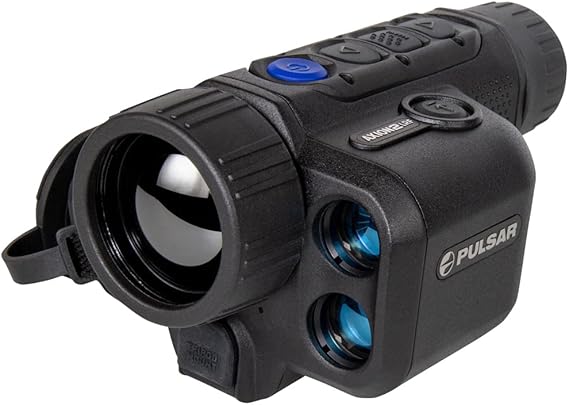
Known for its long-distance laser rangefinder, the Pulsar Axion 2 35mm suits those needing precise thermal detection at extended ranges. Its greatest strength lies in combining sharp imaging with accurate distance measurements, making it ideal for spotting animals or objects from afar.
Setup involves installing one battery, and the manual focus allows you to quickly adjust clarity. Using the built-in laser rangefinder, you can switch between single and continuous scanning for distance, which helps judge your target’s location easily.
The thermal sensor adjusts sensitivity across three levels, offering clear images in different weather and lighting conditions.
Performance delivers sharp thermal images thanks to the 384×288 pixel Lynred sensor, even through fog or darkness. The compact design fits comfortably in hand, and controls let you adjust brightness and contrast to suit view conditions.
Users praise the reliable long-range detection, while some mention the manual focus requires fine tuning in certain environments.
Accuracy of the laser rangefinder is regularly highlighted as a major convenience for quick distance assessment. On the downside, some users note the manual focus can take time to dial in properly to get the clearest picture.
Ideal for anyone needing precise long-range detection with solid thermal imaging. Those wanting automatic focus or wider field views may want to explore other options.
Pros
- Accurate laser rangefinder up to 1,100 yards
- Clear thermal images with Lynred sensor
- Three adjustable sensitivity levels
- Lightweight and compact for easy handling
Cons
- Manual focus needs careful adjustment
- Limited field of view at 10.7 degrees
| Specification | Details |
|---|---|
| Focus Type | Manual Focus |
| Power Source | Battery Powered |
| Field Of View | 10.7 degrees |
| Zoom Ratio | 2-8x |
| Number of Batteries | 1 Product Specific battery included |
| Additional Features | Compact Design, Thermal Imaging |
15. ATN BlazeHunter XD Thermal Imaging Monocular

Exceptional thermal clarity and built-in laser rangefinder make this monocular ideal for serious outdoor enthusiasts needing detailed heat signatures at long distances. Suited for hunting or night surveillance, its sharp thermal images stand out in challenging conditions.
Getting started requires just a single lithium-ion battery, which comes included. Manual focus lets you adjust precisely to your target.
The 2-16x zoom range provides flexibility, and the compact design ensures easy handling during extended use. You can connect it to smartphones or tablets, adding convenience to data sharing and review.
Performance excels with the 1280×1024 VOx sensor delivering ultra-HD thermal images. SharpIR AI improves contrast and edge detail, making targets easier to spot in fog or brush.
The Full HD OLED display provides a crisp view day or night. Built solid and easy to carry, some users find manual focus a bit slow in fast-moving scenarios but praise the accurate, 1,000m rangefinder.
The monocular receives strong praise for delivering clear and crisp thermal images even in fog and dense brush, which helps users identify heat signatures confidently. At the same time, manual focus draws frequent criticism for being less responsive when quick adjustments are needed on moving objects.
Those focusing on detailed thermal imaging at long ranges and valuing reliable distance measurement will find this device well suited. People requiring rapid target acquisition or longer battery life should consider alternatives better optimized for speed and endurance.
Pros
- Ultra-HD thermal clarity in tough conditions
- Integrated, accurate laser rangefinder
- Compact, easy to handle design
- SharpIR AI for better image contrast
Cons
- Manual focus can be slow on moving targets
- Single battery limits extended use without spares
| Specification | Details |
|---|---|
| Ultra-HD Thermal Core | 1280×1024 VOx 12μm sensor |
| Display | 0.49″ 1920×1080 OLED |
| Zoom Ratio | 2-16x |
| Built-In Laser Rangefinder | Up to 1,000m ±1m accuracy |
| Field Of View | 1000 yard |
| Number of Batteries | 1 Lithium Ion battery (included) |
Best Thermal Imaging Monoculars Comparison Table
| Product | Zoom Ratio | Field Of View | Focus Type | Batteries |
|---|---|---|---|---|
| TOPDON TS004 Monocular | – | – | Manual Focus | 1 Lithium Ion |
| RIX Pocket K2 Thermal | – | 19.4 degrees | Fixed Focus | 1 Lithium Ion |
| RIX Pocket K3 Thermal | 2× | 17.5 degrees | Fixed Focus | 1 Lithium Ion |
| AGM Taipan V2 Monocular | 1.5x-12x | 10 degrees | Auto Focus | 2 Nonstandard |
| GOYOJO G210 Thermal | – | – | Fixed Focus | 1 Lithium Polymer |
| Vortex Veil 400 Thermal | Up to 4x Digital | – | Manual Focus | 1 Nonstandard |
| Pulsar Axion Compact | 1.5-6x | 19.5 degrees | Manual Focus | 1 9V |
| Teslong Thermal Monocular | 4 | – | – | 1 Lithium Ion |
| RIX Stride ST3 Lite | – | 17.5 degrees | – | 1 Lithium Ion |
| RIX Titan-T6 LRF | – | – | Manual Focus | – |
| Thermal Master T2 Max | 15 | – | Manual Focus | – |
| Pulsar Oryx LRF XG35 | 2.5-20x | 12.5 degrees | – | 1 Product Specific |
| ATN BlazeTrek 6 | 8x | – | Manual Focus | 1 Nonstandard |
| Pulsar Axion 2 35mm | 2-8x | 10.7 degrees | Manual Focus | 1 Product Specific |
| ATN BlazeHunter XD | 2-16x | 1000 yard | Manual Focus | 1 Lithium Ion |
- Zoom Ratio–
- Field Of View–
- Focus TypeManual Focus
- Batteries1 Lithium Ion
- Zoom Ratio–
- Field Of View19.4 degrees
- Focus TypeFixed Focus
- Batteries1 Lithium Ion
- Zoom Ratio2×
- Field Of View17.5 degrees
- Focus TypeFixed Focus
- Batteries1 Lithium Ion
- Zoom Ratio1.5x-12x
- Field Of View10 degrees
- Focus TypeAuto Focus
- Batteries2 Nonstandard
- Zoom Ratio–
- Field Of View–
- Focus TypeFixed Focus
- Batteries1 Lithium Polymer
- Zoom RatioUp to 4x Digital
- Field Of View–
- Focus TypeManual Focus
- Batteries1 Nonstandard
- Zoom Ratio1.5-6x
- Field Of View19.5 degrees
- Focus TypeManual Focus
- Batteries1 9V
- Zoom Ratio4
- Field Of View–
- Focus Type–
- Batteries1 Lithium Ion
- Zoom Ratio–
- Field Of View17.5 degrees
- Focus Type–
- Batteries1 Lithium Ion
- Zoom Ratio–
- Field Of View–
- Focus TypeManual Focus
- Batteries–
- Zoom Ratio15
- Field Of View–
- Focus TypeManual Focus
- Batteries–
- Zoom Ratio2.5-20x
- Field Of View12.5 degrees
- Focus Type–
- Batteries1 Product Specific
- Zoom Ratio8x
- Field Of View–
- Focus TypeManual Focus
- Batteries1 Nonstandard
- Zoom Ratio2-8x
- Field Of View10.7 degrees
- Focus TypeManual Focus
- Batteries1 Product Specific
- Zoom Ratio2-16x
- Field Of View1000 yard
- Focus TypeManual Focus
- Batteries1 Lithium Ion
How to Choose the Right Thermal Imaging Monocular
Choosing a thermal imaging monocular involves focusing on key features like image resolution, detection range, and battery life to ensure clear viewing and reliable performance. Prioritizing these factors helps avoid costly upgrades and ensures the device meets your specific needs effectively.
Image Resolution and Sensor Quality
Using a handheld thermal device with a low-resolution sensor quickly shows how frustrating it can be to identify objects clearly. The image appears pixelated, making it hard to distinguish fine details or recognize small animals at a distance.
A sensor resolution of at least 320×240 pixels usually produces a clear and sharp thermal image suitable for spotting targets in most conditions.
The refresh rate plays a big role when tracking moving animals or people. Rates below 30 Hz create choppy or laggy visuals, which slows reaction times. Choosing a device with a refresh rate of 30 Hz or higher ensures smooth motion on screen.
The detection range also defines where the device works best. Devices that identify heat signatures beyond 500 meters offer practical use in open areas like fields, whereas shorter ranges suffice for dense woods or urban settings.
Battery Life and Power Options
A single battery charge or set often runs for 4 to 8 hours on average. Devices that recharge via USB tend to be more convenient for daily users than those relying solely on disposable batteries. Rechargeable batteries reduce recurring costs and allow quick top-ups when outlets or power banks are available.
Some models include an auto shut-off after inactivity to preserve battery life.
Changing batteries should be straightforward, especially in cold or wet environments where fumbling with tiny compartments becomes a challenge. Look for designs that enable quick battery swaps without tools, and check whether the manufacturer uses standard AA or proprietary cells, as this affects availability and cost.
Ergonomics and Portability
Carrying a bulky device for hours leads to fatigue, so weight and size matter a lot. Models around 300 to 400 grams feel balanced and easy to hold steady with one hand.
Grips designed with textured rubber or ergonomic contours reduce slippage, while buttons placed within thumb reach simplify adjustments without interrupting observation.
Durability is a daily concern outdoors. Many devices offer some water resistance, usually rated IP54 or better, enabling use during light rain or snow without worry. Shock resistance to withstand accidental drops also increases longevity, making a well-built monocular a better companion on rugged hikes or patrols.
Display and Viewing Experience
The viewing experience depends on the clarity and comfort of the screen or eyepiece. A 640×480 pixel display makes images crisp and easier to interpret, preventing eye strain over extended use.
Screen size often falls between 0.3 to 0.5 inches in diagonal, large enough to see details without making the device bulky.
Adjustable brightness settings and multiple color palettes, such as white hot or rainbow, allow adaptation to different lighting and terrain conditions. Good eye relief, generally around 15 to 20 millimeters, lets users wear glasses while still viewing comfortably.
Field of view varies from 7 to 15 degrees; wider views make scanning areas faster but can reduce detail magnification.
Additional Features and Connectivity
Recording pictures or video not only documents observations but also helps review details missed in real time. Devices with built-in storage or support for microSD cards offer this functionality. Playback on the device itself removes the need for immediate transfers.
Wireless features like Wi-Fi enable remote viewing on smartphones or tablets, which can be handy in team operations or sharing footage instantly. Some models include standard mounting threads compatible with tripods and other gear, useful for steady shots or integrating with riflescopes and helmets.
How to Optimize Thermal Imaging Monocular Performance in Different Environments
Thermal imaging monoculars detect heat signatures, allowing you to see objects based on temperature differences rather than visible light. To get the most out of your device, keep the lens clean and free of obstructions like dirt or moisture, which can affect image clarity. Temperature range and sensitivity matter.
In extreme cold or hot environments, some units will perform better due to their sensor quality and calibration. Using the correct image contrast and brightness settings also improves visibility; adjust these depending on the time of day and weather conditions.
Avoid bright light sources directly in the field of view since they can distort the image. Position yourself so your target is not obscured by obstacles that could block thermal signatures, like thick brush or glass windows.
Carry extra batteries, since cold temperatures can drain power more quickly. Regularly updating your device’s firmware can fix bugs and improve responsiveness in challenging conditions.
Comparing Thermal Imaging Monoculars with Night Vision Devices: Pros and Cons
Thermal imaging monoculars and night vision devices serve different purposes but both help improve visibility in low-light situations. Thermal monoculars detect heat emitted by objects, which means they can work in total darkness and through smoke, fog, or light foliage. Night vision devices amplify existing light, so they perform well in low-light environments but struggle in complete darkness or when visibility is obstructed.
Thermal units generally have simpler images showing heat differences, making it easier to spot living beings, while night vision shows more detailed surroundings in green or black and white hues. On the downside, thermal monoculars can be more expensive and less effective at identifying fine details or colors.
Night vision devices require some ambient light to function and can be affected by sudden bright lights. Both types rely on battery life, so choosing a model that fits your specific nighttime activity is important.
People Also Asked
How Do I Properly Clean and Maintain a Thermal Imaging Monocular?
Use a soft, dry microfiber cloth to clean the lens and avoid harsh chemicals that can damage the sensor. Regularly check for moisture and store the monocular in a dry case to prevent lens fogging and internal issues.
What Size Thermal Monocular Is Ideal for Nighttime Wildlife Observation?
A compact 7 to 9-inch size works well for nighttime wildlife observation since it balances portability with adequate grip and stability. Larger models can feel cumbersome during extended use in the field.
Are Thermal Imaging Monoculars Safe for Prolonged Eye Use?
Prolonged use won’t harm your eyes because thermal imagers detect heat rather than visible light, but take breaks to reduce eye strain from focusing. Regular pauses help maintain comfort over longer observation sessions.
How Long Do Thermal Imaging Monocular Batteries Typically Last?
Battery life commonly ranges from 4 to 8 hours depending on model and usage intensity. Carrying spare batteries or a portable charger ensures you won’t lose tracking on longer outings or unexpected delays.
What Are Common Issues Users Face with Thermal Imaging Monoculars?
Users often encounter issues like lens fogging, battery drain, and image noise under certain conditions. Routine lens cleaning, good battery management, and choosing the right model for your environment help minimize these problems.
Conclusion
Choosing a thermal imaging monocular mainly depends on how clear the image needs to be, the range at which you want to detect heat sources, and how easy the device is to use in the field. Battery life also matters, especially for longer outings where replacing or recharging might not be an option. Taking note of the device’s durability can save problems during rough outdoor use.
Consider your specific needs like the size of the area you’ll monitor and how often you plan to use the monocular. Matching the features with your budget will help avoid spending too much on options you don’t need. Check the comparison table and review sections above to find a model that fits your situation and budget without extra complications.