Top 15 Best Affordable Thermal Monocular You Can’t Miss
Finding the best affordable thermal monocular often comes down to avoiding gear that offers blurry images, short battery life, or a bulky design that’s hard to carry around. Many models on the market promise great performance but struggle in real-world use, especially when you’re trying to find targets or move around in low visibility.
A cheap or poorly chosen thermal monocular might leave you with unclear thermal readings or a device that weighs too much for extended use in the field.
Good thermal monoculars balance resolution, detection range, and battery life. Typically, a decent device has a resolution around 320×240 pixels and can detect heat signatures up to 500 meters or more.
Battery life should be at least 4 to 5 hours for practical use without constant recharging. Weight and size also matter since a bulky unit can be uncomfortable to handle for long stretches, and easy controls help make adjustments on the go without fumbling.
Need a Quick Check?
| Image | Product | Price |
|---|---|---|
Our Top Picks 1  | TOPDON TS004 | Check Price |
Our Top Picks 2  | RIX Pocket K3 | Check Price |
Our Top Picks 3  | AGM Taipan V2 | Check Price |
Our Selected Top 15 Affordable Thermal Monocular for Every Budget
This list features a variety of affordable thermal monoculars suitable for different needs and budgets. Each review covers performance details, ideal user scenarios, strengths, and limitations to help you make an informed choice based on your specific requirements.
1. TOPDON TS004 Thermal Imaging Monocular
Offering clear thermal images with a high IR resolution of 256×192, the TS004 suits outdoor enthusiasts needing reliable night vision without breaking the bank. Its standout feature is the vivid image quality paired with a long-lasting battery, making it practical for extended use in the field.
Setting it up involves simply charging the built-in 5000mAh battery and connecting to your phone using the TopInfrared App for real-time viewing. The manual focus and 8x zoom let you fine-tune your view, while the 13.5-degree field of view provides a good balance between detail and range during daily monitoring or wildlife spotting.
The TS004 delivers detailed thermal images with a smooth 50Hz refresh rate, ensuring steady visuals. It feels solid thanks to its monocentric eye piece lens and compatible equatorial mount.
The battery life of about 11 hours supports long sessions outdoors. Some users note the manual focus can take patience for precise adjustments, but image clarity is consistently praised.
The imaging is notably clear and smooth, letting you spot details easily even outdoors at night. The manual focus system, while effective, sometimes means extra time aligning the image just right. Battery life keeps the device running through long adventures without interruptions.
People wanting a practical monocular for extended nighttime use will appreciate the TS004’s balance of quality and battery endurance. Those needing faster autofocus or a wider view might look for different models better suited to those preferences.
Pros
- Clear thermal imaging with high resolution
- Long battery life up to 11 hours
- Wireless phone connection for live monitoring
- Compact and solid build quality
Cons
- Manual focus requires careful adjustment
- Field of view could feel narrow for some tasks
| Specification | Details |
|---|---|
| IR Resolution | 256×192 |
| Battery Capacity | 5000mAh |
| Refresh Rate | 50Hz |
| Zoom Ratio | 8x |
| Field Of View | 13.5 degrees |
2. RIX POCKET K3 Thermal Monocular
RIX POCKET K3 Thermal Monocular offers sharp thermal imaging in a compact, pocket-friendly design. It suits outdoor enthusiasts and hunters who need clear heat signatures without lugging heavy gear.
Its standout feature is the high-resolution 384×288 sensor combined with a surprising 853-yard detection range under ideal conditions.
Setup is simple thanks to its lightweight, palm-sized frame that fits easily in your hand or pocket. The 2× base magnification and 15mm objective lens provide a balanced view well suited for spotting wildlife or surroundings at night. Wi-Fi connectivity adds convenience, letting you share or review images without hassle.
The built-in tripod mount allows for steady, prolonged viewing sessions.
Performance at detecting heat sources is solid, with clear outlines visible within its given range, though environmental factors naturally influence how far you can spot details. Build quality feels sturdy and compact, designed with portability in mind.
Most users appreciate the sharp image quality; some mention that the 2× zoom can feel a bit limiting for distant targets.
Sharp thermal images come through clearly thanks to the good quality sensor, which most users praise. Commonly noted is that the zoom is only 2×, which can limit how much detail you can see from far away. Weather and terrain also play a role in detection effectiveness.
This monocular works well for those looking for something portable and reliable at close to medium distances. People needing greater zoom or detection in tough environments may want to look for a model with higher magnification or different sensor specs.
Pros
- Compact and lightweight for easy carrying
- High resolution thermal sensor
- Tripod-compatible for stable observation
- Wi-Fi connectivity for image sharing
Cons
- Limited 2× zoom can feel restrictive
- Detection range affected by weather conditions
| Specification | Details |
|---|---|
| Field Of View | 17.5 degrees |
| Zoom Ratio | 2× |
| Compatible Devices | Tripod, Hunting Equipment |
| Mount | 1/4″-20 tripod interface |
| Thermal Sensor Resolution | 384×288 |
3. AGM Global Vision Taipan V2 Thermal Monocular
Picking up the AGM Global Vision Taipan V2 feels solid and straightforward, built for nights spent tracking or scouting out terrain. Its best feature is how sharply it shows heat signatures in the pitch black, making it especially great for hunters or outdoors people who need clear views without light support.
Getting started is simple since it comes with two batteries, and its auto focus saves time adjusting when scanning different areas. The 10-degree field of view coupled with multiple zoom levels from 1.5x to 12x helps to spot both near and far targets with a quick turn of the dial. Connecting it to a smartphone or tablet adds convenience for reviewing or sharing footage on the go.
It performs very well at picking up faint heat differences thanks to its sensitive sub-35mK 12µm detector, delivering crisp images during total darkness. The build feels sturdy without being too heavy to carry for long periods. The most praised aspect is sharp thermal detection; however, some mention occasional lag in the digital zoom adjustment.
Sharp and clear thermal detection stands out as the biggest plus, delivering dependable views in dark conditions. Some users note the digital zoom doesn’t respond instantly, which can slow quick target adjustments. The overall build supports extended outdoor use without feeling cumbersome.
Those frequently monitoring at night or scouting rugged outdoor spots will find it a good match. Folks needing instant zoom response or using standard batteries might want to consider other options better suited to those preferences.
Pros
- Clear thermal imaging even in total darkness
- Auto focus for quick adjustments
- Wide zoom range 1.5x to 12x
- Includes batteries and smartphone compatibility
Cons
- Digital zoom can be slow to adjust
- Requires nonstandard batteries
| Specification | Details |
|---|---|
| Thermal Detector Sensitivity | sub-35mK 12µm |
| Field Of View | 10 degrees |
| Zoom Ratio | 1.5x-12x |
| Focus Type | Auto Focus |
| Number of Batteries | 2 Nonstandard Battery batteries required (included) |
| Smartphone Compatibility | Yes |
4. Thermal Master T2 Max Thermal Monocular

Excellent for spotting wildlife in complete darkness, this affordable thermal monocular suits outdoor enthusiasts and night explorers. Its strongest feature is the ability to detect heat signatures at long distances, letting you see animals or other heat sources in fog or heavy vegetation with reliable clarity.
Setup is straightforward with manual focus controlled by a 15mm lens that adjusts easily for different viewing ranges. It runs on batteries, so no need to worry about cords.
The monocular connects to a smartphone for reviewing images on a bigger screen. Day-to-day use feels practical due to its clear thermal imaging, which comes especially handy during nighttime birdwatching or farm monitoring.
Performance delivers a sharp thermal view up to 910 yards, with enhanced image resolution that doubles the native sensor quality. It’s sturdy enough for outdoor conditions, though some users note that manual focusing can slow quick target acquisition. The build feels solid, and the thermal sensor sensitivity is impressive for the price point.
Most praise points to the clear thermal images and long detection range, helping to spot animals even in challenging conditions. The frequent complaint centers on the manual focus slowing down quick adjustments when targets move fast.
The device suits anyone needing clear thermal views for wildlife or nighttime observation within medium distances. Those requiring rapid focus adjustment or higher native resolution may want to look for alternatives with autofocus or larger sensors.
Pros
- Detects heat sources up to 910 yards away
- Manual focus adjusts image clarity smoothly
- Connects to smartphone for image viewing
- Works well through fog, darkness, and vegetation
Cons
- Manual focus can be slow when tracking moving targets
- Image resolution limited by native sensor size
| Specification | Details |
|---|---|
| Power Source | Battery Powered |
| Focus Type | Manual Focus |
| Thermal Sensor | 256×192, 15mK NETD sensitivity |
| Focal Length | 15mm |
| Zoom Ratio | 15 |
| Additional Feature | X³ Super Resolution |
5. RIX Pocket K2 Thermal Monocular
Lightweight and compact enough to fit in a pocket, the RIX Pocket K2 suits outdoor enthusiasts who need a reliable thermal monocular without bulk. Its biggest strength lies in the clear visual quality delivered by its 800×600 OLED display that’s sharper than many in its price range.
Setting up takes seconds since it runs on a single included lithium-ion battery. Carrying it around is easy due to its size and weight, lighter than most smartphones.
Its 19.4-degree field of view and fixed focus mean you don’t have to fuss with adjustments during quick observations while hiking or exploring. A tripod mount adds stability when needed, and smartphone compatibility lets you capture what you see.
Performance on detecting subtle temperature differences is solid thanks to the 12μm sensor and NETD under 25mK, which many find reliable in varied weather. The fully multi-coated lens helps bring out details, though some mention fixed focus can feel limiting in certain situations.
Build quality is IP67 waterproof, tough enough for rugged conditions, making it very dependable on the go.
Visual clarity stands out as a highlight due to the OLED display and sensor quality, but some users find the fixed focus limits precision for certain distances. The waterproof build adds confidence in outdoor use.
People needing quick, sharp thermal images in a compact size will appreciate the convenience here. Those who want adjustable focus or longer battery life might want to explore other options.
Pros
- Lightweight and pocketable design
- High contrast, detailed OLED display
- Good thermal sensitivity under 25mK
- Includes tripod mount and smartphone compatibility
Cons
- Fixed focus limits some close-up clarity
- Single battery may require frequent recharging
| Specification | Details |
|---|---|
| Resolution | 256×192 |
| Display | 800×600 OLED |
| Field Of View | 19.4 degrees |
| Focus Type | Fixed Focus |
| Power Source | 1 Lithium Ion battery |
| Waterproof Rating | IP67 |
6. GOYOJO G210 Thermal Monocular

Impressive clarity in thermal imaging stands out for anyone looking to spot heat signatures easily. Ideal for outdoors enthusiasts, security patrols, or nighttime explorers, it offers clear visibility in low light with a reliable thermal sensor.
Getting started is straightforward since it runs on a single lithium polymer battery included in the box. The fixed focus lens means no constant adjustments, which makes using it on the go less fiddly. Its handheld size and the ability to attach it to a tripod add flexibility.
Changing color palettes keeps the view easy on the eyes depending on surroundings, and you can record images with the built-in storage.
The 256×192 thermal sensor with a 12μm infrared detector reliably picks up heat, helping identify animals or people in darkness. The body feels solid with multi-coated lenses that improve image clarity. Most users praise its clear thermal pictures and ease of use.
Some notice the limited 2x zoom might restrict spotting objects far away.
Clear thermal images make spotting heat sources straightforward, and changing between six color modes helps adapt to lighting conditions. Common feedback points out the limited zoom range as a drawback when looking at distant objects. Battery life meets regular use expectations with a convenient included lithium polymer battery.
Anyone needing dependable, easy-to-use thermal imaging at night or in low light will find it suitable. Those requiring longer-range spotting should consider devices with higher zoom ratios or integrated finderscopes for enhanced target acquisition.
Pros
- Six display color palettes for varied environments
- Includes 16GB storage for capturing images
- Fixed focus reduces need for constant adjustment
- Tripod mount option provides stable viewing
Cons
- Only 2x zoom may limit distance observation
- No finderscope for quick targeting
| Specification | Details |
|---|---|
| Thermal Sensor Resolution | 256×192 |
| Infrared Detector | 12μm |
| Zoom Ratio | 2 |
| Field Of View | 17.5 degrees |
| Power Source | 1 Lithium Polymer battery (included) |
| Focal Length | 10 millimeters |
7. Digital Night Vision Monocular
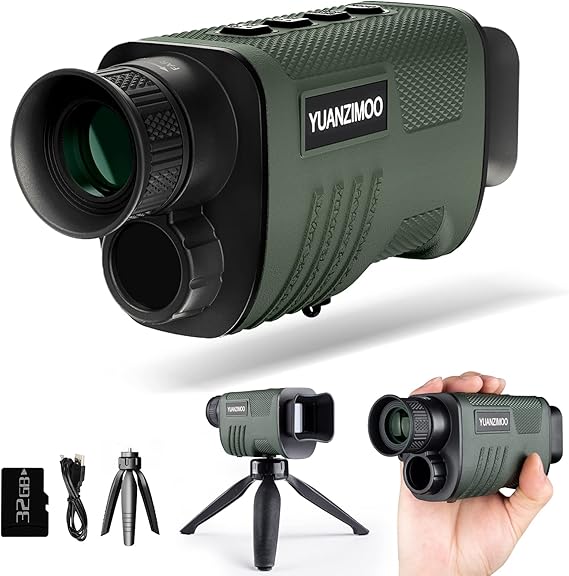
Perfect for outdoor explorers wanting clear night vision without spending too much, this Digital Night Vision Monocular works well in complete darkness thanks to its 7 infrared illumination levels. It suits those needing reliable vision in low light and a rechargeable battery option that lasts through long use.
Setting it up involves manually focusing through the Plössl eyepiece lens and adjusting the 7 IR levels depending on how dark it is. The rechargeable 2000 mAh battery offers convenience, and the auto shut-off feature helps save power.
It’s easy to carry around and can be charged on the go with a power bank or car charger, making it practical for outdoor adventures.
Performance is solid with an 8x zoom and clear vision provided by the 1.3MP FHD CMOS sensor, even in total darkness. The monocular feels well built with multi-coated optics and uses a durable lithium-ion battery. Common praise centers on the bright, detailed night view, while the main drawback users note is the need for manual focus adjustment, which can slow quick spotting.
The brightest and clearest images come from the adjustable infrared illumination, making night use effective even in total darkness. Most users find the manual focus slows quick target acquisition, which can be tricky in fast-paced situations.
Those needing a simple, rechargeable night vision device for planned outdoor activities will appreciate this model. Users requiring instant focus or more flexible mounts might want to look at other options better suited for rapid adjustments or advanced setups.
Pros
- Rechargeable 2000 mAh battery included
- 7 infrared illumination levels for dark conditions
- 1.3MP FHD CMOS sensor for clear images
- Can be charged by power bank or car charger
Cons
- Manual focus requires careful adjustment
- Altazimuth mount limits some shooting angles
| Specification | Details |
|---|---|
| Power Source | Battery Powered |
| Number of Batteries | 1 Lithium Ion battery required (included) |
| Zoom Ratio | 8 multiplier x |
| Field Of View | 984 feet |
| Eye Piece Lens Description | Plössl |
| Focus Type | Manual Focus |
8. Pulsar Axion Compact Thermal Monocular

Tracking game or scanning terrain in thick brush can be tricky without clear vision. Pulsar Axion Compact Thermal Monocular offers sharp mid-range heat detection, making it suitable for hunters or outdoor enthusiasts who want reliable thermal imaging without breaking the bank. Its standout feature is the crisp, detailed display that cuts through fog and low light conditions effectively.
Setting it up is straightforward thanks to its single 9V battery, which is included. The manual focus lets you fine-tune the view, and the compact design feels comfortable for prolonged hand-held use.
The AMOLED display stays clear and responsive even in cold or humid weather, helping you spot subtle heat differences easily during daily tracking or scouting sessions.
Performance-wise, the 384×288 uncooled thermal sensor delivers sharp images with good contrast, even in fog or rain. The 1.5-6x zoom helps adjust your view without losing clarity.
The body feels solid, made for outdoor conditions, though some note the manual focus can be a bit fiddly under stress. On the plus side, the vivid display greatly improves target detection.
Highly praised for its vivid AMOLED display that performs well in fog and low contrast, the monocular helps spot heat sources clearly. Manual focus is often mentioned as difficult to adjust quickly, which might slow down moment-sensitive use.
Hunters and outdoor users needing reliable thermal imaging in various weather will appreciate this device. People looking for autofocus or longer battery options might want to explore other models.
Pros
- Sharp thermal imaging with <20 NETD sensor
- Clear 640×400 AMOLED display
- Compact and comfortable design
- Detects subtle heat differences
Cons
- Manual focus can be challenging under pressure
- Limited to one battery type
| Specification | Details |
|---|---|
| Eye Piece Lens Description | Uncooled microbolometer detector |
| Focus Type | Manual Focus |
| Power Source | Battery Powered |
| Number of Batteries | 1 9V batteries required. (included) |
| Field Of View | 19.5 degrees |
| Zoom Ratio | 1.5-6x |
9. ATN BlazeSeeker 6 Thermal Monocular

460 meters detection range makes this thermal monocular ideal for spotting heat signatures across wide open fields. Perfect for wildlife watchers and outdoor enthusiasts who need clear, reliable thermal imaging without breaking the bank.
Setup is straightforward thanks to fixed focus and battery-powered operation. The 10 mm germanium lens provides a narrow field of view for focusing on distant targets, while the 1.7–13.6X zoom adjusts comfortably. The compact and lightweight design means carrying it around is simple, and the diopter adjustment helps get a sharp image without fuss.
Thermal detection is sharp with a 256×192 sensor and ≤20 mK NETD sensitivity, delivering clear contrast and recognition of animals or people. Build quality feels solid without excess bulk.
The best part is how detailed the heat signatures appear even in complex backgrounds. Some find the view slightly narrow for very close distances, which limits quick wide-area scanning.
Heat signatures appear clearly and sharply, making it efficient for identifying targets at long range. Some users note difficulty scanning fast due to the narrow 17.3-degree field of view. The battery type can also require keeping spares on hand given its nonstandard nature.
Those focusing on open terrain will appreciate the detection distance and image clarity, while people wanting broader scanning should look at options with wider views. Easy portability and solid imaging suit casual observers over heavy-duty use.
Pros
- Clear heat detection up to 460 m distance
- Lightweight and compact design for easy carry
- Multiple color palettes for comfortable viewing
- Video and photo capture capabilities
Cons
- Narrower field of view limits quick scanning
- Uses nonstandard battery, less convenient
| Specification | Details |
|---|---|
| Sensor Resolution | 256×192 |
| Lens Focal Length | 10 mm germanium lens |
| Field Of View | 17.3 degrees |
| Zoom Ratio | 1.7–13.6X |
| Display | 800×600 OLED |
| Power Source | 1 Nonstandard Battery |
10. GOYOJO SENTRA315 Thermal Monocular

Someone who spends time outdoors observing wildlife or navigating low-visibility environments will find this thermal monocular handy. Its standout feature is the ability to show clear shapes, not just heat spots, making it easier to spot animals or objects in complex backgrounds.
Getting started is straightforward since it runs on a single included battery. Wearing it on your head keeps hands free and makes it easy to scan your surroundings at a steady 50 Hz refresh rate, which means images stay smooth even when tracking moving subjects. Manual focus lets you adjust quickly to different distances, and the 1x-3x digital zoom helps bring things closer without losing clarity.
In use, the image quality stands out for showing defined outlines, thanks to the 384 x 288 resolution sensor combined with a light-gathering F1.0 lens. The build feels solid and is designed for helmet compatibility, making it practical for many outdoor activities. The most appreciated aspect is how it reduces motion blur, while a common critique is the limited field of view at 12.5 degrees, which can sometimes feel narrow.
Clear outlines and reduced motion blur stand out as the biggest advantages for users needing sharp images of wildlife or objects. Most users mention the narrow field of view as the main drawback, which can hinder quick scanning of wider areas.
Those who value detailed thermal images and plan to wear the device hands-free will appreciate this model. People needing a wider field of view or standard battery options may want to explore other options.
Pros
- Clear shape detection in low contrast environments
- 50 Hz refresh rate reduces motion blur
- Lightweight, head-mounted with helmet compatibility
- Manual focus allows quick adjustment
Cons
- Narrow 12.5-degree field of view limits peripheral sight
- Uses a nonstandard battery, requiring spares
| Specification | Details |
|---|---|
| Resolution Sensor | 384×288 |
| Refresh Rate | 50 Hz |
| Field of View | 12.5 degrees |
| Zoom Ratio | 1x-3x Digital Zoom |
| Focal Length | 20mm |
| Power Source | 1 Nonstandard Battery (included) |
11. RIX Stride ST3 Lite 384 Thermal Monocular

Designed specifically for helmet mounting, this thermal monocular stands out by offering true 1× magnification to keep your natural surroundings visible without distortion. Suited for hunters, patrol officers, or night explorers, it works well when you need hands-free thermal vision without sacrificing situational awareness.
Setup is straightforward with a single lithium-ion battery included, and mounting options cover helmets, tripods, or vehicles. Day-to-day use easily switches between handheld and mounted modes, making it practical for everything from night patrols to outdoor search tasks.
The wide 17.5-degree field of view lets you scan efficiently without constant repositioning.
It performs solidly in thermal detection while maintaining clear image perception thanks to its 1× base magnification. The build feels durable enough for outdoor wear, and the adjustable magnification adds flexibility.
Most common praise highlights hands-free viewing without image distortion; the frequent complaint concerns the limited field of view compared to some other models.
The device’s biggest strength is allowing hands-free thermal viewing with accurate spatial awareness thanks to its true 1× magnification. Users note it works consistently well for night patrol or hunting, but some find the field of view not quite as wide as desired for scanning large areas quickly.
This thermal monocular suits those who need a reliable, helmet-mounted solution that keeps surroundings clear. People requiring broader views or longer battery life might want to explore alternatives. It fits well for varied roles from vehicle patrol to handheld use without added bulk or complexity.
Pros
- True 1× magnification for natural perception
- Versatile mounting options included
- Wide 17.5-degree field of view
- Compact and lightweight design
Cons
- Field of view narrower than some competitors
- Single battery operation limits runtime
| Specification | Details |
|---|---|
| Mount | Handheld/Helmet Mount |
| Compatible Devices | Helmet Mount, Tripod, Vehicle Mount |
| Number of Batteries | 1 Lithium Ion batteries required. (included) |
| Field Of View | 17.5 degrees |
| Additional Features | Helmet-Mounted Design, Wide Field of View, Adjustable Magnification |
12. Athlon Optics Cronus ATS P-Mini 250S Thermal Monocular

Athlon Optics Cronus ATS P-Mini 250S fits well for anyone needing a reliable thermal monocular with a sharp image and easy-to-use interface. It stands out for its crisp thermal sensor and a bright full-color touchscreen that helps you spot heat signatures clearly in various conditions.
Setting up involves mounting and screwing it into place, which comes included. The touchscreen is straightforward, letting you adjust brightness, contrast, and pick from seven color palettes to suit the environment you’ll be using it in.
The integrated WiFi lets you record or transfer images and videos to your phone without extra steps, making day-to-day use smooth.
It performs its main function by providing a clean, high-resolution thermal image with a good detection range. The plastic build keeps it light and practical, though some users note it could feel less durable. The five-year warranty offers solid reassurance.
People love how clear the OLED display is but occasionally mention the plastic material feeling less rugged than expected.
The standout feature is the clear thermal image from the 12μm sensor combined with the bright OLED touchscreen for comfortable viewing. Common feedback points to the plastic body feeling a bit less rugged than some would expect for outdoor gear.
This device suits those looking for an affordable, lightweight thermal monocular for casual or semi-professional use. Users needing extremely durable gear for rough conditions might want to consider other options with stronger materials.
Pros
- High-resolution thermal sensor
- Full-color OLED touchscreen display
- WiFi app for direct media transfer
- Adjustable brightness and contrast
Cons
- Plastic build can feel less sturdy
- Small screen size may limit viewing
| Specification | Details |
|---|---|
| Brand Name | Athlon Optics |
| Model Name | CRONUS ATS P-MINI 250S |
| Touchscreen Display | 1.43” OLED full-color |
| Sensor | 12μm pixel thermal sensor |
| Warranty | 5 year warranty |
| Included Components | mount and screws |
13. xGen2 Night Vision Thermal Monocular

Using the xGen2 Night Vision Thermal Monocular feels like having night vision on demand, especially for anyone who needs clear thermal imaging in low-light conditions without breaking the bank. Its strongest feature is the built-in infrared illuminator that helps you see at distances up to 70 yards even in total darkness.
Setting it up is straightforward with mounting options for Picatinny and Weaver rails, making it easy to attach to gear. Day-to-day, switching between five preset modes is handy since you can adjust infrared levels and frame rates depending on how dark it is or what you need to see. The compact design keeps it comfortable to hold for extended use without extra weight getting in the way.
Thermal images remain crisp out to the full 70-yard range, making tracking animals or objects in the dark practical. The device feels solidly built, suited for outdoor use although some mention it could be tougher in rough conditions. Most users appreciate how well the IR illuminator works but sometimes want a wider field of view or faster refresh rate.
The powerful infrared illuminator extends visibility in complete darkness well, but some users feel the screen could benefit from a wider field of view. The device handles night conditions effectively in various settings, though occasional remarks highlight the desire for smoother mode transitions.
Outdoor enthusiasts looking for affordable thermal imaging with versatile mounting will find this suitable. Those needing very wide viewing angles or rapid frame updates might want to explore other options that better match those specific requirements.
Pros
- Built-in powerful IR illuminator for darkness
- Five pre-programmed sensor modes
- Mounts easily on common rails
- 70-yard effective viewing distance
Cons
- Field of view may feel narrow to some
- Frame rate adjustments can feel limited
| Specification | Details |
|---|---|
| Mounting Type | Picatinny Mount, Weaver Mount |
| Field Of View | 70 yard |
| Thread Type | 1/2″-28 UNC |
14. Handheld Thermal Imaging Monocular

Affordable thermal imaging with clear temperature readings suits anyone needing quick HVAC inspections. Its standout feature is the precise temperature range from -20°C to 550°C with good accuracy, making it reliable for various thermal tasks without breaking the bank.
Setup is straightforward since it includes one lithium-ion battery, so it’s ready to go out of the box. The 2.4 TFT LCD screen with 320×240 resolution makes daily use comfortable because images are sharp enough to identify heat patterns on walls or equipment. Bright red buttons are easy to find even in low light, speeding up work during inspections.
Performance holds up well thanks to a 240×240 infrared resolution detector, capturing detailed thermal images. It’s built solidly yet stays light at 13.4 ounces, easy to carry around. The clearest praise is its accuracy in temperature measurement; the common gripe revolves around the screen size feeling a bit small for prolonged monitoring sessions.
Accurate temperature readings get frequent praise, ensuring reliability during HVAC inspections or home checks. Many note the compact screen as the main drawback, which can strain eyes in long assessments. The simple layout and lightweight design speed up regular tasks without confusion.
People needing a budget-friendly, dependable thermal monocular for straightforward temperature checks will find satisfaction here. Those requiring larger displays or advanced imaging features may prefer stepping up to pricier models for their work demands.
Pros
- Precise temperature range from -20°C to 550°C
- Lightweight at 13.4 ounces for easy handling
- Clear 2.4″ color LCD with 320×240 resolution
- Includes rechargeable lithium-ion battery
Cons
- Screen size may be too small for extended viewing
- Limited advanced features compared to higher-end models
| Specification | Details |
|---|---|
| Infrared Resolution | 240×240 pixels |
| Screen Size & Resolution | 2.4″ TFT LCD, 320×240 |
| Temperature Range | -20°C to 550°C |
| Temperature Accuracy | ±2°C |
| Item Weight | 13.4 ounces |
| Power Source | 1 Lithium Ion battery (included) |
15. TNV30i Thermal Monocular

Built with precision optics and powered by a smart AI engine, the TNV30i suits anyone needing a clear thermal image without breaking the bank. Its standout feature is delivering sharp, detailed images thanks to the 12 µm pixel size and 512×384 resolution, perfect for outdoor enthusiasts or security watchers.
Setup involves pairing the device with the Mileseey T-Recon app, which guides you through just three steps for optimal clarity. Switching on Super-Resolution, selecting the Forest image mode, and fine-tuning the focus ring lets you quickly lock on to your target. The app compatibility adds convenience in adjusting settings on the fly during use.
Image quality is impressive due to the proprietary Matrix IV AI engine, with thermal sensitivity detecting subtle heat differences. The build is compact at 1.39 pounds, making it easy to carry around, and the durable design handles outdoor conditions well.
Users often praise the image sharpness, though some mention the manual focus can be a bit fiddly at first.
The thermal image quality stands out thanks to AI and high resolution, making details pop even in complex outdoor scenes. Some find the manual focus adjustment challenging initially, which slows down getting a perfect view until familiar with it.
This fits well for users comfortable with smartphone apps and wanting detailed thermal images for hiking or surveillance. It may not suit those preferring fully manual controls or simpler setups without relying on external devices.
Pros
- Sharp image detail with AI-driven processing
- Lightweight and easy to carry
- App integration for quick setup
- Detects small temperature differences clearly
Cons
- Manual focus can require patience
- Requires app for full functionality
| Specification | Details |
|---|---|
| Pixel Size | 12 µm |
| Resolution | 512×384 Super Resolution (196,608 pixels) |
| Thermal Sensitivity | NETD < 20 mK |
| Weight | 1.39 pounds |
| Dimensions | 9.37 x 7.01 x 2.44 inches |
Best Affordable Thermal Monoculars Comparison Table
| Product | Mount | Focus Type | Compatible Devices | Battery |
|---|---|---|---|---|
| TOPDON TS004 | Equatorial Mount | Manual Focus | Smartphone | 1 Lithium Ion |
| RIX Pocket K3 | 1/4″-20 tripod interface | – | Tripod, Hunting Equipment | – |
| AGM Taipan V2 | Altazimuth Mount | Auto Focus | Smartphone, Tablet | 2 Nonstandard |
| Thermal Master T2 Max | – | Manual Focus | Smartphone | – |
| RIX Pocket K2 | Tripod Mount | Fixed Focus | Smartphone | 1 Lithium Ion |
| GOYOJO G210 | Tripod Mount | Fixed Focus | Smartphone | 1 Lithium Polymer |
| Digital Night Vision | Altazimuth Mount | Manual Focus | Camera, Smartphone | 1 Lithium Ion |
| Pulsar Axion Compact | – | Manual Focus | – | 1 9V |
| ATN BlazeSeeker 6 | – | Fixed Focus | Smartphone | 1 Nonstandard |
| GOYOJO SENTRA315 | Head-mounted | Manual Focus | Helmet | – |
| RIX Stride ST3 Lite | Handheld/Helmet Mount | – | Helmet Mount, Tripod | 1 Lithium Ion |
| Athlon Cronus ATS P-Mini | – | – | – | – |
| xGen2 Night Vision | Picatinny, Weaver Mount | – | – | – |
| Handheld Thermal Monocular | – | – | – | 1 Lithium Ion |
| TNV30i Thermal | – | – | – | – |
- MountEquatorial Mount
- Focus TypeManual Focus
- Compatible DevicesSmartphone
- Battery1 Lithium Ion
- Mount1/4″-20 tripod interface
- Focus Type–
- Compatible DevicesTripod, Hunting Equipment
- Battery–
- MountAltazimuth Mount
- Focus TypeAuto Focus
- Compatible DevicesSmartphone, Tablet
- Battery2 Nonstandard
- Mount–
- Focus TypeManual Focus
- Compatible DevicesSmartphone
- Battery–
- MountTripod Mount
- Focus TypeFixed Focus
- Compatible DevicesSmartphone
- Battery1 Lithium Ion
- MountTripod Mount
- Focus TypeFixed Focus
- Compatible DevicesSmartphone
- Battery1 Lithium Polymer
- MountAltazimuth Mount
- Focus TypeManual Focus
- Compatible DevicesCamera, Smartphone
- Battery1 Lithium Ion
- Mount–
- Focus TypeManual Focus
- Compatible Devices–
- Battery1 9V
- Mount–
- Focus TypeFixed Focus
- Compatible DevicesSmartphone
- Battery1 Nonstandard
- MountHead-mounted
- Focus TypeManual Focus
- Compatible DevicesHelmet
- Battery–
- MountHandheld/Helmet Mount
- Focus Type–
- Compatible DevicesHelmet Mount, Tripod
- Battery1 Lithium Ion
- Mount–
- Focus Type–
- Compatible Devices–
- Battery–
- MountPicatinny, Weaver Mount
- Focus Type–
- Compatible Devices–
- Battery–
- Mount–
- Focus Type–
- Compatible Devices–
- Battery1 Lithium Ion
- Mount–
- Focus Type–
- Compatible Devices–
- Battery–
How to Choose the Right Affordable Thermal Monocular
Key factors to consider include image quality, detection range, battery life, and durability, as these directly affect performance and usability. Choosing a monocular that balances these well prevents overspending on unnecessary features and ensures reliable operation in various conditions.
Image Resolution and Sensor Quality
Noticing tiny temperature differences can be the difference between spotting an animal or missing it entirely in low visibility. Sensitivity in the thermal sensor directly impacts this ability. Monoculars that detect finer temperature gradients reveal more subtle details, which improves the clarity of the thermal image.
Resolution also plays a major role; a higher pixel count delivers a sharper image, making it easier to recognize shapes and identify targets. Most affordable models offer resolutions between 240×180 and 384×288 pixels, with the latter providing noticeably crisper images.
Sensor refresh rate affects how smoothly moving objects are tracked, rates around 30Hz provide decent real-time observation without lag, while slower rates can cause motion blur or choppiness during rapid movement.
Detection Range and Field of View
The effective distance for spotting heat sources varies significantly between models. Some handheld thermal viewers pick up signatures clearly at 300 meters, while others range up to 600 meters or more. This impacts the choice depending on whether the user is hunting close to medium range or conducting perimeter security over a wider area.
A wide field of view helps scan large areas quickly but reduces zoom capability, making objects appear smaller. Zoom, on the other hand, allows closer inspection but narrows the visible scene.
Balancing these depends on intended use:
- Wide field for general scouting
- Zoom for identifying targets at distance
Battery Life and Power Options
Long operational time means less downtime swapping batteries or recharging in the field. Practical use often demands 4–6 hours of continuous run on a single battery charge or fresh disposable set.
Rechargeable lithium-ion batteries are common and convenient, but some models also accept standard AA or CR123 batteries for quick replacement.
Power consumption affects overall portability since frequent recharging or carrying extra batteries adds bulk. Thermal monoculars built with energy-efficient sensors and displays tend to last longer and weigh less.
Users working extended shifts benefit from models optimized for low power draw.
Durability and Weather Resistance
Daily rough handling and unexpected drops quickly reveal the build quality. Durable units usually have rubberized outer shells or reinforced plastic that cushion impacts.
Drop resistance ratings (around 1 to 2 meters) show if a device sustains common field accidents.
Water and dust resistance ratings like IP66 or IP67 indicate suitability for wet or dusty environments, critical for outdoor use. A compact, lightweight design improves hand comfort and pocketability, reducing strain on longer excursions while maintaining rugged construction.
User Interface and Ease of Use
Simplicity of controls makes a difference when operating in the dark or cold. Monoculars with straightforward buttons and easy menu navigation help users adjust settings quickly without fumbling. Displays with high contrast and adjustable brightness improve readability under varied lighting conditions, whether dawn, dusk, or artificial light.
Additional options such as image capture, video recording, or wireless connectivity add practical value but may complicate the interface. A well-organized menu system avoids overwhelming users and keeps essential functions within easy reach.
Tips for Maximizing Performance with Your Thermal Monocular
Adjusting the focus on your thermal monocular is crucial for getting a clear image. Many models come with manual or automatic focus; take the time to find the right setting for the environment. Avoid pointing the device at large heat sources, like the sun or vehicle engines, as this can saturate the image and reduce detail in other areas.
Keep the lens clean. Dirt, fingerprints, or moisture can block infrared radiation and blur the view. Use a soft lens cloth and lens cleaner designed for optics to maintain clarity.
For extended use, consider using a tripod. Handheld stability can affect image sharpness, especially at higher magnifications. A steady base helps in scanning areas without tiring your hand, which improves observation accuracy.
- Check battery levels before heading out; low power can degrade image quality.
- Experiment with device settings like color palettes or contrast to suit different environments.
- Store the monocular in a protective case to avoid physical damage and dust buildup.
Common Mistakes to Avoid When Using an Affordable Thermal Monocular
One common mistake is using thermal monoculars through glass or windows. Glass blocks infrared radiation completely, resulting in no thermal image or a severely distorted one. Always use the device outdoors or through open spaces for accurate thermal detection.
Avoid rushing the focusing process. An out-of-focus image can look like the device isn’t working correctly, leading to frustration.
Take a moment to adjust focus carefully, especially when switching viewing distances.
Do not expose your monocular to extreme temperatures or moisture, as budget models often have limited weather resistance. Prolonged exposure can damage internal electronics.
- Ignoring the user manual can lead to misuse or missed features; review it thoroughly.
- Assuming thermal images can identify specific objects without context often leads to misinterpretation.
- Failing to breathe steadily while observing can cause slight hand movement and blurry images.
People Also Asked
How Do I Properly Care for My Thermal Monocular?
Store the thermal monocular in a dry, cool place and clean the lens with a soft cloth to prevent scratches. Avoid touching the lens with your fingers as oils can damage the coating. Always use the protective case when not in use to keep dust and moisture away.
What Size Thermal Monocular Is Best for Handheld Use?
A compact and lightweight monocular around 5 to 7 inches is best for handheld use because it’s easier to hold steady. Larger models can be tiring over time, especially for extended viewing sessions. Try holding the unit before buying to see what feels comfortable in your hand.
Are Thermal Monoculars Safe to Use Around Children?
Thermal monoculars emit no harmful light and are generally safe around children, but supervision is recommended. Teach kids to handle the device gently to avoid dropping or damaging it. Avoid prolonged use close to their eyes to prevent strain from viewing the screen.
How Long Does the Battery Typically Last in Thermal Monoculars?
Battery life varies, but many affordable models offer 4 to 6 hours of continuous use on a full charge. Carrying extra batteries or a power bank is helpful for longer outings. Turning off the device when not in use conserves battery life significantly.
What Are Common Problems with Affordable Thermal Monoculars?
Common issues include lower image resolution, slower refresh rates, and shorter battery life compared to higher-end units. Some models may also have less durable construction, so watch for signs of wear or loose parts. Reading user reviews helps spot consistent problems before purchasing.
Conclusion
Focus on image clarity, battery life, and detection range when choosing an affordable thermal monocular. Clear images help identify objects or animals in low visibility.
Longer battery life allows for extended use without frequent recharging. A sufficient detection range ensures you can spot targets at the distances you need.
Match the monocular’s features to your environment and how often you plan to use it. Spending a bit more makes sense if it’s for regular use, while occasional users might prioritize simplicity and cost. Review the comparison table and the detailed picks above to find a good balance that fits your specific needs.