Top 15 Best Thermal Monocular for Hunting You Can’t Miss
Choosing the best thermal monocular for hunting can make a big difference during low-light conditions. Many struggle with units that offer blurry images or short battery life, which ruins critical moments in the field. A monocular that lacks durability or is too bulky also becomes a burden during long hunts, especially in rough terrain.
Reliable thermal vision means the difference between spotting game hidden by brush or walking past without a clue.
What separates a solid thermal monocular from a poor one comes down to three main factors: image resolution, detection range, and battery life. Good models typically provide at least 320×240 thermal resolution for clear details and detect animals from 600 to 800 yards. Battery life should last several hours to cover extended use without recharging.
The housing needs to be rugged and weather resistant, often rated to handle moisture and drops. Size matters too, as lighter units under a pound are easier to carry all day in your pack or on gear.
Need a Quick Check?
| Image | Product | Price |
|---|---|---|
Our Top Picks 1  | TOPDON TS004 | Check Price |
Our Top Picks 2  | Vortex Veil 400 | Check Price |
Our Top Picks 3  | Pulsar Oryx LRF | Check Price |
Our Selected Top 15 Thermal Monocular for Hunting You Can Trust
This list highlights fifteen thermal monoculars designed for hunting, detailing each device’s performance, ideal user, and key advantages and drawbacks. Readers will gain clear insights to help choose a suitable option based on their specific needs and conditions.
1. TOPDON TS004 Thermal Imaging Monocular
Boasting a high IR resolution of 256×192 and a smooth 50Hz refresh rate, this thermal monocular offers clear images ideal for hunting in low light or total darkness. It suits hunters who need sharp thermal details to spot game without interruption thanks to its long battery life.
Daily use involves manual focusing with the 13mm monocentric lens, which is straightforward once you get the hang of it. The wireless connection to a smartphone using the TopInfrared App allows real-time monitoring, making it easy to check your surroundings without peering through the eyepiece constantly. The 8x zoom and 13.5-degree field of view help pinpoint targets at various distances.
Performance stands out with vivid thermal imaging and reliable battery life that lasts up to 11 hours on a single charge. The build feels solid, designed to work outdoors comfortably, though the manual focus requires some patience.
Strongest praise highlights its unmatched image clarity, while common complaints revolve around the focus mechanism feeling a bit fiddly.
Users find image clarity outstanding, capturing every thermal detail with precision during hunting sessions. However, adjusting the manual focus takes some getting used to, which slows quick target acquisition occasionally. The wireless phone link improves monitoring but depends on app stability.
This monocular fits well for those prioritizing clear, detailed thermal imaging and long battery operation on hunts. Individuals needing faster autofocus or a wider field of view might prefer other options better tailored to quick, broad scanning.
Pros
- Clear thermal images with high IR resolution
- Long battery life for extended outings
- Wireless phone connection for live monitoring
- Compact, easy to carry design
Cons
- Manual focus can feel a bit tricky
- Field of view might feel narrow for some
| Specification | Details |
|---|---|
| IR Resolution | 256×192 |
| Refresh Rate | 50Hz |
| Battery Capacity | 5000mAh |
| Battery Life | Up to 11 hours |
| Field of View | 13.5 degrees |
| Zoom Ratio | 8x |
2. Vortex Veil 400 Thermal Monocular
Hunters looking for clear thermal imaging during night excursions will appreciate the Veil 400. It suits anyone needing sharp visuals and reliable target detection at long distances, with its biggest strength being a detailed 400×300 resolution sensor that helps spot game up to 1100 yards away.
Setting it up is straightforward, thanks to manual focus and balanced optics that make field adjustments easy. Day-to-day use benefits from a 25mm objective lens and multiple digital zoom levels (1×, 2×, 4×), allowing you to identify targets without losing much field of view. Capturing photos and videos is quick with a dedicated button, supported by 32 GB of internal memory for easy save and share.
The device performs well under low light and total darkness, delivering smooth imaging at 50 Hz refresh rate. Build quality holds up well in rugged outdoor conditions, though some mention the single nonstandard battery can be a hassle. High praise centers on the clear color palettes and sharp contrast, while the main gripe involves battery availability and replacement.
Users frequently praise the sharp, detailed image quality and versatile color palettes that work well for night hunting. On the downside, the nonstandard battery type causes inconvenience due to its limited availability and the need for careful replacement.
People focused on long-range game detection and recording their experience will find the Veil 400 very useful. Those who want a simpler power solution or prefer autofocus might want to explore other thermal devices to better suit their needs.
Pros
- Clear thermal images at long distances
- Multiple digital zoom levels for target ID
- Large built-in memory for photos/videos
- Four color palettes suit different conditions
Cons
- Uses a nonstandard battery, tricky to replace
- Manual focus might require adjustment in the field
| Specification | Details |
|---|---|
| Resolution | 400×300 thermal sensor |
| Pixel Pitch | 12µm |
| Refresh Rate | 50 Hz |
| Magnification | 2.3× base, digital zoom up to 4× |
| Memory | 32 GB built-in |
| Batteries | 1 Nonstandard Battery |
3. Pulsar Oryx LRF XG35 Thermal Monocular
Exceptional imaging in challenging conditions sets the Pulsar Oryx LRF XG35 apart for hunters targeting clear thermal visuals day and night. Ideal for those needing reliable detection capabilities through fog, rain, or dense foliage, it excels in providing sharp, detailed images with impressive field of view and zoom levels.
Setting up involves loading the included battery, giving it power right away without fuss. The 35mm lens strikes a good balance between range and detail, while the AMOLED 1024×768 display makes spotting heat signatures easy during both day and night hunts.
Adjusting zoom from 2.5x to 20x lets you focus on distant game or scan wide areas quickly. Portability keeps it handy for long outings or quick looks.
The thermal sensor provides crisp imaging even when visibility is poor, making this tool a reliable companion in the field. Its sturdy construction feels durable and ready for rugged outdoor use. Complaints commonly focus on a somewhat narrow 12.5° field of view, which can feel limiting when scanning large areas, but praise highlights its reliable performance in tough weather conditions.
The most praised feature is the clear thermal imaging it provides even in challenging weather like fog or rain. However, users often mention the narrow 12.5° field of view as a downside that can restrict wide-area scanning. The device handles detailed detection well but requires careful aiming due to the viewing angle.
Hunters needing detailed target identification and reliability in poor visibility will appreciate this unit. Those who need a broader viewing range for quicker area sweeps might prefer a monocular with a wider field of view. It serves best when long-range clarity outweighs expansive scan areas.
Pros
- Exceptional clarity in fog and dense foliage
- Flexible zoom from 2.5x up to 20x
- AMOLED display delivers bright, clear images
- Portable design for easy carrying
Cons
- Field of view limited to 12.5 degrees
- Uses only specific included batteries
| Specification | Details |
|---|---|
| Focal Length Description | 35mm |
| Field Of View | 12.5 degrees |
| Zoom Ratio | 2.5-20x |
| Eye Piece Lens Description | Digital/Electronic |
| Number of Batteries | 1 Product Specific batteries required. (included) |
| Compatible Devices | Rifles |
4. RIX Titan-T6 Thermal Monocular with Laser Rangefinder

RIX Titan-T6 Thermal Monocular with Laser Rangefinder excels at long-range detection for serious hunters who want accurate distance measurement and ballistic data. Its single biggest strength lies in combining a high-resolution OLED display with an integrated laser rangefinder and ballistic calculator, enhancing precision on the hunt.
Setting it up involves manual focusing through a 35mm lens and a straight-through finderscope that keeps things straightforward in the field. The OLED screen delivers crisp imaging at 1920×1080, making spotting clear even in challenging conditions.
Integrated advanced electronic image stabilization steadies your view, while retained image technology on digital zoom helps keep your target in sight after moving the monocular.
Performance-wise, the monocular can detect heat signatures up to 1818 yards and precisely range targets up to 1312 yards with its laser rangefinder. Build quality is solid, designed for rugged outdoor environments with an altazimuth mount for steady aiming.
Common praise highlights the clear, bright display and reliable distance measurements, while some users mention the weight as a drawback during extended use.
The crisp and bright OLED display combined with an accurate laser rangefinder makes spotting and ranging precise and reliable. Common feedback points to the unit’s weight as a minor inconvenience during longer hunts and manual focusing as needing attention to maintain sharpness.
Hunters who prioritize long-distance detection paired with precise ranging and ballistic data will find this device well-suited. Those looking for a lighter or auto-focus option might explore other models better tailored to lightweight or quick-use preferences.
Pros
- High-resolution 1920×1080 OLED display
- Integrated laser rangefinder up to 1312 yards
- Ballistic calculator improves shot accuracy
- Advanced image stabilization feature
Cons
- Manual focus can require frequent adjustment
- Heavier weight for prolonged handheld use
| Specification | Details |
|---|---|
| Objective Lens | 35mm |
| Detector Resolution | 640×480 |
| Display | 1920×1080 0.49-inch OLED |
| Rangefinder Distance | Up to 1312 yards |
| Detection Range | Up to 1818 yards |
| Additional Features | Laser Rangefinder & Ballistic Calculator, Image Stabilization |
5. RIX Pocket K2 Thermal Monocular

Feels surprising just how light the RIX Pocket K2 is, slipping into a pocket with ease and making it a true grab-and-go thermal monocular for hunters and outdoor explorers. Its standout feature is the 800×600 OLED display, which delivers crisp visuals that help distinguish animals even in tough conditions.
Getting started involves inserting the included lithium-ion battery and powering it on. The fixed focus lens simplifies use in the field, so no fiddling with settings during a hunt. The device pairs with smartphones for added convenience.
Thanks to its pocketable size and IP67 waterproof rating, carrying it around on hikes or trips doesn’t feel like a burden or risk overall damage.
The 256×192 resolution sensor with a 50Hz refresh rate captures clear, detailed heat signatures and smooth motion. The built-in electronic image stabilization keeps the view steady.
Made with fully multi-coated optics, it’s tough enough for rough outdoor use but some mention the fixed focus lens limits zoom versatility. The standout is clearly its light weight, considered by many as being less than a smartphone.
The unit offers excellent visual clarity through its 800×600 OLED display and smooth 50Hz refresh, making spotting subtle temperature differences straightforward. Well known for being very lightweight, it slips easily into pockets and handles outdoor use thanks to its IP67 waterproof rating. However, the fixed focus lens can feel restrictive for users wanting variable zoom options.
Anyone looking for a compact, durable thermal monocular with great image quality and simple use will appreciate this. It suits those who prioritize portability and daily carry over advanced zoom control. Those needing adjustable focus and extended battery life might want to explore other models.
Pros
- Incredibly lightweight, easier than a smartphone
- High refresh rate of 50Hz for smooth image
- IP67 waterproof, reliable in rough conditions
- Resolution enhanced technology for sharper images
Cons
- Fixed focus limits flexibility on zoom
- Single battery may require carry extras for longer trips
| Specification | Details |
|---|---|
| Resolution | 256×192 |
| Display | 800×600 OLED |
| Field Of View | 19.4 degrees |
| Zoom Ratio | 7 |
| Power Source | 1 Lithium Ion battery (included) |
| Waterproof Rating | IP67 |
6. GOYOJO G210 Thermal Monocular

Great for anyone needing reliable thermal imaging on the go, it excels at fast, clear detection in varied lighting. Its standout feature is the quality thermal sensor that quickly picks out heat signatures, making it handy for hunting or spotting animals in low visibility.
Setup is straightforward with a single lithium polymer battery included, and the fixed focus lens means no fussing with adjustments. Switching through six color palettes like White-Hot or Rainbow lets you adapt the display to different environments.
The 4X zoom helps to get a closer look, and 16GB of internal storage means plenty of room to save images during your outings. Its handheld design fits comfortably for scanning around.
Performance delivers clear thermal images thanks to the 256×192 sensor and 12μm infrared detector. The multi-coated Plossl eyepiece lens maintains image clarity and reduces reflections. Build feels solid with a tripod mount option adding stability.
Positive notes highlight impressive detection speed and sharpness, while some mention the limited 2x zoom ratio as a drawback for more detailed viewing.
Its main praise comes from the quick and sharp thermal sensing, which makes detecting heat signatures easy even in challenging light. The most frequent complaint relates to the digital zoom and fixed focus, which restricts fine detail visibility at longer ranges.
This will suit hunters needing a reliable, easy-to-use monocular for general scanning and identifying animals. Those requiring higher zoom levels or adjustable focus might want to look at other models.
Pros
- Fast thermal detection in diverse lighting
- Six customizable color palettes
- Comfortable handheld use with tripod mount option
- Generous 16GB internal image storage
Cons
- Zoom limited to 2x despite 4X digital zoom mention
- Fixed focus lens limits clarity at varied distances
| Specification | Details |
|---|---|
| Sensor Resolution | 256×192 |
| Field Of View | 17.5 degrees |
| Zoom Ratio | 2 |
| Power Source | 1 Lithium Polymer battery (included) |
| Image Storage | 16GB |
| Focal Length | 10 millimeters |
7. RIX Pocket K3 Thermal Monocular
Compact and lightweight design makes it easy to carry in your pocket or hand while out hunting. It suits anyone needing a reliable thermal monocular that offers clear imaging at an affordable price.
Its strongest point is the high-resolution 384×288 thermal sensor delivering detailed thermal views for spotting game.
Setting it up is straightforward, with a user-friendly interface and a tripod mount for steady observation during long waits. The 2× zoom and 17.5° horizontal field of view help focus on targets without losing context.
Wi-Fi connectivity adds convenience by allowing image sharing or viewing on other devices in the field.
Its thermal imaging detects heat signatures effectively up to 853 yards in ideal conditions, though actual range varies. The build feels solid and practical for outdoor use. Reviews mention the clear and crisp image as a big plus, while some users find the zoom limited and performance affected by tricky weather or terrain conditions.
Most users appreciate the clear, high-resolution thermal images that help identify game effectively. The most common downside involves the limited zoom and performance varying under different environmental conditions, which can be noticeable in dense terrain or poor weather.
Hunters needing a lightweight, portable monocular with dependable image quality will find it useful. Those requiring stronger zoom or more consistent range in challenging conditions might consider alternative devices better suited for specialized needs.
Pros
- Compact size fits easily in hand or pocket
- High-resolution thermal sensor provides clear images
- Includes tripod interface for stable viewing
- Wi-Fi connectivity for convenient sharing
Cons
- Limited 2× zoom may not suit all needs
- Detection range affected by weather and terrain
| Specification | Details |
|---|---|
| Field Of View | 17.5 degrees |
| Zoom Ratio | 2× |
| Mount | 1/4″-20 tripod interface |
| Thermal Sensor Resolution | 384×288 |
| Objective Lens | 15mm |
8. AGM Global Vision Taipan V2 Thermal Imaging Monocular

Sharp thermal imaging quality stands out instantly with the AGM Global Vision Taipan V2, ideal for hunters needing clear visibility in complete darkness. It suits outdoor enthusiasts who want reliable heat detection while scanning open fields or tricky terrain at night.
Its single biggest strength is the precise thermal detection that picks up even faint heat signatures.
Setting it up is straightforward, with two included nonstandard batteries powering the device right out of the box. Auto focus and an altazimuth mount make adjusting quick, while the multiple digital zoom levels ranging from 1.5x to 12x let you customize your view for both close and long-range observations. The wide 10-degree field of view helps to cover plenty of ground without constantly shifting position.
Smartphone compatibility adds extra value by allowing easy recording and sharing of important sightings.
Performance delivers sharp, clear imaging thanks to the highly sensitive sub-35mK 12m detector, even when conditions are pitch black. The monocular’s build feels durable and ready for outdoor use, but some people note the weight can become noticeable after extended use.
Most praise focuses on its clarity and zoom flexibility, while common complaints mention battery life and the need to handle it carefully to maintain optimal function.
Sharp, clear thermal images work well in total darkness, thanks to its sensitive detector, while some users find the weight tiring during long sessions. The zoom and wide view bring flexibility, yet battery performance can limit extended use without spares.
Hunters who prioritize image clarity and adjustable zoom will appreciate this unit. Those needing lightweight gear or long battery life for prolonged outings might want to consider other options.
Pros
- Clear imaging with sub-35mK thermal detector
- Wide field of view covers large areas
- Multiple digital zoom levels for flexible use
- Compatible with smartphones for easy recording
Cons
- Heavier than some other handheld monoculars
- Battery life may require frequent replacements
| Specification | Details |
|---|---|
| Eye Piece Lens Description | Standard/Wide-field |
| Mount | Altazimuth Mount |
| Focus Type | Auto Focus |
| Field Of View | 10 degrees |
| Zoom Ratio | 1.5x-12x |
| Number of Batteries | 2 Nonstandard Battery batteries required (included) |
9. RIX Stride ST6 Lite 640 Thermal Monocular

Helmet-mount design makes this thermal monocular perfect for hands-free use during hunting. It keeps your natural view at 1× magnification, so your surroundings don’t feel distorted. Ideal for hunters who need a compact, versatile thermal tool without sacrificing natural sight or ease of use.
Setup involves mounting it directly on your helmet or switching to handheld or vehicle modes with compatible mounts. The wide 17.5-degree field of view means scanning around is easier without moving your head awkwardly.
Single lithium-ion battery powers it, making day-to-day use straightforward. Lightweight and compact design fits comfortably whether on your head or in hand.
The thermal sensor captures clear images with adjustable magnification to spot targets at night or in low visibility. Built tough for outdoor use, it balances solid construction with portable size. Common praise highlights how natural the view remains when helmet-mounted.
Some find the battery life limiting during longer outings, which might require spares.
Natural 1× magnification on the helmet keeps the surroundings looking real and easy to scan, which reviewers appreciate for hunting. Most complaints relate to the battery life not lasting very long, suggesting carrying extras for longer sessions.
Hunters wanting hands-free thermal viewing and natural sight will find this device fitting well into their routine. Those needing longer battery endurance or higher magnification might want to explore other models for their specific needs.
Pros
- True 1× magnification preserves natural surroundings
- Compact and light for helmet or handheld use
- Wide 17.5° field of view helps tracking targets
- Single included lithium-ion battery for simple power
Cons
- Battery life may fall short on extended outings
- Some users may prefer higher magnification options
| Specification | Details |
|---|---|
| Mount | Helmet and Vehicle Mount |
| Compatible Devices | Helmet Mount, Tripod, Vehicle Mount |
| Number of Batteries | 1 Lithium Ion batteries required. (included) |
| Field Of View | 17.5 degrees |
| Additional Features | Helmet-Mounted, Wide FOV, Adjustable Magnification, Compact & Versatile Design |
10. Pulsar Axion 2 35mm Thermal Monocular
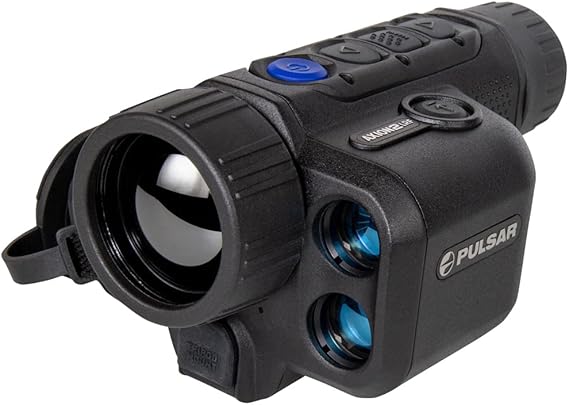
Spotting game at long distances during low light or complete darkness demands precision, and the Pulsar Axion 2 35mm thermal monocular makes that possible. Perfect for hunters who want clear detection of animals without complicated setups, its standout feature is the built-in long-distance laser rangefinder with impressive accuracy.
Daily use feels straightforward with manual focus and a compact design that’s easy to handle in the field. The battery powers it reliably, and compatibility with smartphones or tablets lets you share images or adjust settings on the go.
Different sensitivity levels and image filters help you adapt to changing weather and terrain.
Performance matches its specs well, providing clear thermal images thanks to the Lynred sensor with good resolution. The zoom range from 2x to 8x zoom gives flexibility when scanning terrain or animals.
Build quality feels solid and practical for rough outdoor use. Most praise highlights the rangefinder accuracy, while the manual focus requires some getting used to.
Clear detection of animals at long range stands out due to its precise laser rangefinder, while manual focus is the most common hurdle during use. Adjusting focus takes time to get right but rewards with sharp images.
Hunters who need reliable long-distance measurements and adaptable imaging will find this monocular useful. Those wanting quick autofocus or extended battery life may want to explore other options.
Pros
- Accurate laser rangefinder up to 1,100 yards
- Clear thermal images with Lynred sensor
- Compact and easy to carry
- Compatible with smartphones and tablets
Cons
- Manual focus can take time to master
- Single battery might limit extended use
| Specification | Details |
|---|---|
| Focus Type | Manual Focus |
| Power Source | Battery Powered |
| Zoom Ratio | 2-8x |
| Finderscope | Reflex |
| Compatible Devices | Smartphone, Tablet |
11. Pulsar Telos LRF Thermal Monocular

Offering built-in rangefinding alongside thermal imaging makes this a solid choice for hunters needing accuracy and clear visuals in low-light conditions. It suits those who want a dependable, easy-to-handle monocular that performs well in tough terrain.
Precision and clarity stand out as key strengths.
Setting up involves manual focus, which feels straightforward once you get the hang of it. The nonslip rubber coating gives a confident grip even when things get wet or chilly outside. Powered by a single battery that’s included, it’s ready to go almost instantly.
A smartphone can connect to it for added convenience during longer hunts.
Seeing through darkness and spotting animals at various distances works very well thanks to Pulsar Image Boost Technology. The body is tough and designed to handle rough outdoor conditions without slipping. Most users mention excellent image clarity, but some find the manual focus takes a bit to master in fast situations.
Many find the clarity produced by Image Boost Technology to be excellent for detecting animals in darkness, giving hunters confidence. However, the manual focus requires some patience and practice to use effectively under time pressure during a hunt.
People prioritizing accurate thermal imaging and value in rough conditions will appreciate this monocular. Those needing instant autofocus or longer battery life might look for a different option.
Pros
- Clear thermal images aided by advanced Image Boost tech
- Comfortable, nonslip rubber coating for secure grip
- Built-in rangefinder delivers useful distance measurement
- Compatible with smartphones for extra functionality
Cons
- Manual focus can slow quick target acquisition
- Single battery limits continuous use without spare
| Specification | Details |
|---|---|
| Focus Type | Manual Focus |
| Power Source | Battery Powered |
| Compatible Devices | Smartphone |
| Number of Batteries | 1 Product Specific battery required (included) |
| Additional Features | Built-In Rangefinder, Portable, Thermal Imaging |
12. ATN BlazeHunter Pro 3.5-28x50mm Thermal Monocular

Hunters looking for a reliable thermal monocular that works well in varied conditions will find great value here. Its standout feature is the built-in laser rangefinder, which adds precision to spotting and distance measurement. Ideal for serious hunters wanting clear thermal imaging packed with useful extras.
Starting up is straightforward with the fixed focus lens, so you can quickly zero in on your target without fiddling with adjustments. The large full-color OLED display makes viewing easy in different light settings.
Lightweight design helps reduce fatigue during long treks. The built-in Wi-Fi means sharing images or videos onsite is quick and painless.
Thermal detection is sharp thanks to the pro-grade image sensor below 18Mk NETD, which highlights heat signatures with clarity. The video recording function captures all the action for later review.
Constructed to be light yet durable enough for outdoor hunting. Main praise highlights its detailed imagery and user-friendly features. Common complaint involves the fixed focus not suiting all distances perfectly.
Users appreciate the sharp, colorful OLED display and the built-in laser rangefinder as key helpers during hunts. The main drawback lies in the fixed focus, which doesn’t always deliver perfect clarity across all ranges, especially at very close or very far distances.
Hunters seeking precision measurement and easy video documentation will be satisfied. Those needing adjustable focus for variable distances might look for different models better suited to changing environments. The lightweight but sturdy build ensures comfortable use in the field.
Pros
- Built-in laser rangefinder for accurate distance checks
- Long-lasting battery life supports extended use
- Video recording captures all observations efficiently
- Lightweight design suits long hunting sessions
Cons
- Fixed focus limits clarity at some distances
- May require learning curve to use all features fully
| Specification | Details |
|---|---|
| Focus Type | Fixed Focus |
| Focal Length | 3.5-28mm |
| Zoom Ratio | 8 |
| Additional Features | Built-In Laser Rangefinder, Video Recording, Full-Color High Definition OLED Display |
| Compatible Devices | Rifles |
13. Pulsar Telos Thermal Imaging Monocular
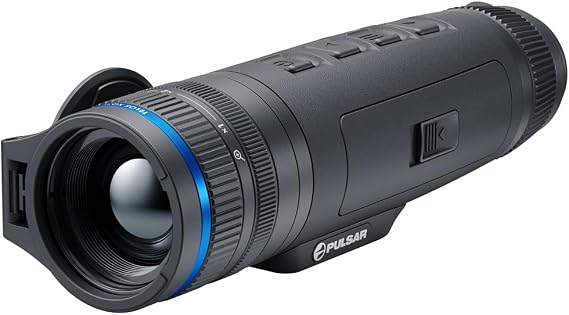
Designed for serious nocturnal hunters, the Pulsar Telos XQ35 stands out for its long detection range and clear thermal imaging. Perfect for those who need reliable performance in complete darkness, its strength lies in the advanced Image Boost Technology that sharpens details in low-light scenarios.
Setup involves inserting a single included battery, and the manual focus lets you adjust precisely based on distance. Its portable size and multi-coated eyepiece lens make it comfortable to hold for extended periods.
The 10.7-degree field of view offers enough scanning room without sacrificing detail, while compatibility with smartphones helps with sharing or recording sightings.
Performance delivers strong detection with a 384×288 sensor and visibility up to 1,421 yards, which makes identifying targets at long range doable. The build feels solid yet lightweight for hiking out at night. Many appreciate the clarity provided by the Image Boost feature, though some mention the manual focus requires adjustment patience in changing conditions.
The standout feature is the clear thermal imaging at long distances, particularly in low light, which makes spotting game easier even in tough conditions. Many find the manual focus a bit fiddly, requiring you to stay patient as you fine-tune it while out in the field.
Hunters who prioritize detection range and image detail will appreciate this monocular’s capabilities and portability. For those wanting quicker, hands-free focus or longer battery life, exploring other options might be worth considering.
Pros
- Long-range detection up to 1,421 yards
- Image Boost Technology improves low-light clarity
- Lightweight and portable design
- Compatible with smartphones for sharing footage
Cons
- Manual focus needs frequent adjustment
- Single battery life can limit long outings
| Specification | Details |
|---|---|
| Thermal Imaging Sensor | 384×288 <25mK NETD |
| Detection Range | 1,421 yards |
| Eye Piece Lens Description | Multi-Coated |
| Focus Type | Manual Focus |
| Field Of View | 10.7 degrees |
| Number of Batteries | 1 (included) |
14. ATN BlazeHunter Pro 2.5-20x35mm Thermal Monocular

ATN BlazeHunter Pro 2.5-20x35mm Thermal Monocular is built for hunters who want detailed, clear thermal imaging. Its standout feature is the less than 18Mk NETD image sensor that delivers sharp, high-definition views, making it ideal for spotting game at various distances with ease and confidence.
Setting up the monocular is straightforward, with an intuitive menu on the full-color OLED display. The built-in laser rangefinder helps estimate distances right away, while multiple viewing modes let you switch depending on weather or terrain. Long battery life keeps you going through long hunting sessions, and lightweight construction means it won’t weigh down your gear.
Wi-Fi transfer means sharing videos or images is quick and painless.
Performance is strong thanks to the HD OLED screen and high-grade sensor giving clear images day or night. The body feels solid but not bulky, helping with easy hand-held use.
People often praise precise laser rangefinding and video recording capabilities. On the downside, some find the package weight a bit heavy for its size and wish the eye cup was more comfortable after extended use.
The clarity of the high-definition OLED display combined with the precise laser rangefinder gets a lot of positive attention. Some notice the overall package feels a little heavy and that the eyecup isn’t ideal for long periods of use. These are the main points in everyday use.
Hunters looking for sharp image quality and reliable distance measurement will appreciate this monocular. Those needing ultra-lightweight gear or extended comfort might look for a different option better suited to long treks.
Pros
- High-definition full-color OLED display
- Integrated laser rangefinder for distance measuring
- Long-lasting battery keeps it powered for hours
- Lightweight design makes it easy to carry
Cons
- Package weight feels heavy relative to size
- Eyecup can get uncomfortable during extended use
| Specification | Details |
|---|---|
| Image Sensor | Pro-Grade less than 18Mk NETD |
| Magnification | 2.5-20x |
| Objective Lens | 35mm |
| Display | Full-Color High Definition Oled |
| Weight | 4 pounds (package) |
| Warranty | 3 Year |
15. ATN BlazeHunter XD Thermal Imaging Monocular

Feels incredibly clear and sharp, making it easy to spot animals even in dense brush or low light. Suited for hunters who want precise thermal imaging combined with distance measurement. Its biggest strength lies in delivering crisp thermal details in tricky conditions, which helps locate game with confidence.
Setup is straightforward, coming with batteries, charger, and a neck strap all ready to go. The Full HD OLED display offers a bright, high-contrast view that remains comfortable during extended use at night. The built-in laser rangefinder allows quick distance checks up to 1,000 meters with strong accuracy, helping to plan shots carefully in the field.
Performance is impressive thanks to its 6th generation Ultra-HD thermal core providing a 1280×1024 VOx sensor resolution and fast 50Hz refresh rate, making heat signatures stand out clearly. The device feels solid in hand, with durable construction suited for outdoor conditions. Most praise centers on the sharp image and rangefinder, while some mention the weight as a bit noticeable during long hunts.
SharpIR AI enhancement greatly improves image clarity, making animals easier to spot in tough conditions. The main complaint revolves around its weight, which can feel cumbersome during long hunting sessions. The 5-year warranty backs its reliability for serious outdoor use.
Hunters prioritizing detailed thermal detection and range measurement will appreciate this model. Those looking for a lightweight or mountable option might want to consider alternatives better suited for extended carry or integration.
Pros
- Sharp thermal images in darkness and fog
- Accurate built-in laser rangefinder
- Long-lasting battery with charger included
- Comfortable Full HD OLED display
Cons
- Some users find it a bit heavy for prolonged use
- Limited to handheld use, no mounting options mentioned
| Specification | Details |
|---|---|
| Sensor Resolution | 1280×1024 VOx 12μm |
| Sensitivity | ≤15mK |
| Refresh Rate | 50Hz |
| Display | 0.49″ 1920×1080 Full HD OLED |
| Rangefinder Distance | Up to 1,000m with ±1m accuracy |
| Included Accessories | 2 Batteries, Charger, Cable, Neck Strap, Pouch |
Best Thermal Monoculars for Hunting Comparison Table
| Product | Focus Type | Zoom Ratio | Battery | Compatible Devices |
|---|---|---|---|---|
| TOPDON TS004 | Manual Focus | – | 1 Lithium Ion | Smartphone |
| Vortex Veil 400 | Manual Focus | Up to 4x Digital | 1 Nonstandard Battery | Rifles |
| Pulsar Oryx LRF | – | 2.5-20x | 1 Product Specific | Rifles |
| RIX Titan-T6 LRF | Manual Focus | – | – | – |
| RIX Pocket K2 | Fixed Focus | – | 1 Lithium Ion | Smartphone |
| GOYOJO G210 | Fixed Focus | – | 1 Lithium Polymer | Smartphone |
| RIX Pocket K3 | – | 2× | – | Tripod, Hunting Equipment |
| AGM Taipan V2 | Auto Focus | 1.5x-12x | 2 Nonstandard Battery | Smartphone, Tablet |
| RIX Stride ST6 | – | – | 1 Lithium Ion | Helmet Mount, Tripod |
| Pulsar Axion 2-35 | Manual Focus | 2-8x | 1 Product Specific | Smartphone, Tablet |
| Pulsar Telos LRF | Manual Focus | – | 1 Product Specific | Smartphone |
| ATN BlazeHunter Pro 50 | Fixed Focus | 8 | – | Rifles |
| Pulsar Telos | Manual Focus | – | 1 Product Specific | Smartphone |
| ATN BlazeHunter Pro 35 | – | – | – | – |
| ATN BlazeHunter XD | – | – | 2 Batteries Included | – |
- Focus TypeManual Focus
- Zoom Ratio–
- Battery1 Lithium Ion
- Compatible DevicesSmartphone
- Focus TypeManual Focus
- Zoom RatioUp to 4x Digital
- Battery1 Nonstandard Battery
- Compatible DevicesRifles
- Focus Type–
- Zoom Ratio2.5-20x
- Battery1 Product Specific
- Compatible DevicesRifles
- Focus TypeManual Focus
- Zoom Ratio–
- Battery–
- Compatible Devices–
- Focus TypeFixed Focus
- Zoom Ratio–
- Battery1 Lithium Ion
- Compatible DevicesSmartphone
- Focus TypeFixed Focus
- Zoom Ratio–
- Battery1 Lithium Polymer
- Compatible DevicesSmartphone
- Focus Type–
- Zoom Ratio2×
- Battery–
- Compatible DevicesTripod, Hunting Equipment
- Focus TypeAuto Focus
- Zoom Ratio1.5x-12x
- Battery2 Nonstandard Battery
- Compatible DevicesSmartphone, Tablet
- Focus Type–
- Zoom Ratio–
- Battery1 Lithium Ion
- Compatible DevicesHelmet Mount, Tripod
- Focus TypeManual Focus
- Zoom Ratio2-8x
- Battery1 Product Specific
- Compatible DevicesSmartphone, Tablet
- Focus TypeManual Focus
- Zoom Ratio–
- Battery1 Product Specific
- Compatible DevicesSmartphone
- Focus TypeFixed Focus
- Zoom Ratio8
- Battery–
- Compatible DevicesRifles
- Focus TypeManual Focus
- Zoom Ratio–
- Battery1 Product Specific
- Compatible DevicesSmartphone
- Focus Type–
- Zoom Ratio–
- Battery–
- Compatible Devices–
- Focus Type–
- Zoom Ratio–
- Battery2 Batteries Included
- Compatible Devices–
How to Choose the Right Thermal Monocular
Choosing a thermal monocular with the right resolution, detection range, and battery life ensures clear images and reliable performance during hunts. Prioritizing durability and ease of use also reduces frustration and replacement costs, making the investment more worthwhile over time.
Image Resolution and Refresh Rate
Viewing thermal images with poor resolution and low refresh rates can quickly frustrate anyone trying to identify game accurately. A low resolution produces blurry images that make it hard to distinguish animals from background clutter, while a slow refresh rate results in a choppy display that can cause you to lose track of moving targets.
Devices with at least 320×240 resolution offer noticeably sharper images suitable for recognizing shapes and movement in real time. Refresh rates around 30Hz or higher provide fluid motion, which is essential when scanning through dense brush or tracking fast wildlife.
Finding a balance between resolution and refresh rate matters most during situations such as dawn or dusk hunts when lighting and animal movement challenge your vision. High-resolution models with fast refresh deliver clearer, smoother visuals, but can demand more battery power and be pricier.
Lower specs struggle to maintain detail and smooth tracking, making it harder to react quickly.
Detection Range and Field of View
The ability to detect game at long distances opens opportunities to spot animals before they become startled. Effective detection ranges for these devices typically span 500 to 1,000 yards for medium-sized game, matching the needs of forest and open field environments.
A unit with too short a range limits how early you can notice potential targets, forcing closer approaches and increasing risk.
Field of view affects scanning and target focus. A wider angle, around 20 to 30 degrees, helps in quickly surveying large hunting areas but reduces detail per square inch, while a narrower view below 15 degrees sharpens the image on one target but demands more time to scan. Balancing these involves prioritizing situational awareness or detailed examination depending on terrain and typical game behavior.
Battery Life and Power Source
Hunting trips often last several hours or even days, making battery longevity a critical factor. Continuous use times typically range from 4 to 10 hours. Falling short means risking a dead device mid-hunt or carrying extra batteries.
Many models use rechargeable lithium-ion batteries, which are lightweight and offer longer runtimes but require charging infrastructure. Others accept common AA or CR123 batteries, which can be swapped easily in remote areas without power access.
The battery type also influences the thermal scope’s weight; rechargeable packs add bulk but reduce the need for carrying multiple spares. Devices designed with quick battery swaps let you stay longer in the field without downtime. Checking the estimated operational hours and compatibility with available power sources ensures your device doesn’t quit before you do.
Durability and Weather Resistance
Devices regularly exposed to rain, dust, cold, and bumps face a harsh environment in the field. Many thermal monoculars feature sealing standards like IP67 or IP68 to resist water and dirt intrusion, which prevents malfunction during sudden weather changes.
Durable bodies usually consist of reinforced plastics or aluminum alloys that can withstand drops and shocks encountered when climbing or walking rough terrain.
Shock resistance matters because accidental impacts happen frequently during movement or packing. A well-built unit survives falls without losing calibration or damaging the sensor. Cold tolerance is important in winter hunts to avoid sluggish electronics or screen issues.
Prioritizing durable construction and weather ratings ensures your gear works reliably over multiple seasons without needing repairs.
Ergonomics and Ease of Use
Comfortable grip and straightforward controls reduce hand fatigue and allow steady aiming during lengthy observation periods. Rubberized or textured surfaces improve grip, especially when wearing gloves or in wet conditions.
Devices with buttons or dials positioned for easy access let you adjust zoom, brightness, or color palettes without interrupting scanning.
Compact size and light weight improve portability and mounting options on tripods or firearms. Bulky or heavy units can be cumbersome to carry and tiring to hold steadily. Balancing ergonomics involves selecting models that fit your hand well and offer menus simple enough to operate instinctively, so you spend more time looking out than fiddling with settings.
Maximizing Hunting Efficiency: Practical Tips for Using Thermal Monoculars in the Field
Thermal monoculars reveal heat signatures, making it easier to spot game in low light or dense cover. To use one effectively, keep it steady and scan slowly across open areas or along game trails.
Quick movements reduce detection of subtle heat contrasts. Adjust the brightness and contrast settings for clearer images under different conditions, such as fog or heavy brush.
Key tips for better results:
- Carry a tripod or mount if you plan to use the device for extended periods; this reduces hand shake and fatigue.
- Focus on temperature differences rather than shapes; warm animals stand out against cooler backgrounds.
- Note that glass, water, and certain materials can block thermal readings, avoid looking through them.
- Use the device during dawn or dusk when temperature differences between animals and surroundings are greatest.
Employing these straightforward habits helps spot animals quicker and with more accuracy in various outdoor conditions.
Maintaining Your Thermal Monocular: Essential Care and Troubleshooting for Longevity
Routine maintenance prolongs the life of a thermal monocular and keeps images clear. Wipe the lens gently with a microfiber cloth after each use to remove dust and oil.
Avoid touching the lens directly with fingers. Store the device in a padded case to protect it from bumps and moisture.
Common care and troubleshooting steps:
- Charge batteries regularly and avoid completely draining them to maintain battery health.
- Keep the device dry; moisture can damage internal electronics if water-resistant sealing fails.
- When the screen flickers or the image quality drops, try performing a soft reset or check the manufacturer’s site for firmware updates.
- Allow the monocular to acclimate when moving between extreme temperatures to prevent fogging inside.
Following these simple practices ensures your thermal monocular remains reliable and functional over years of use in the field.
People Also Asked
How Do I Properly Clean and Maintain a Thermal Monocular?
Use a soft cloth and lens-cleaning solution designed for optics to clean the lens. Avoid using harsh chemicals or rough materials. Store the device in a dry place with the lens cap on to prevent dust buildup and moisture damage.
What Size Thermal Monocular Is Ideal for Hunting Trips?
A compact and lightweight thermal monocular around 7 to 10 inches long works well for hunting. It’s easier to carry all day without straining your hands or neck. A model that fits comfortably in your jacket pocket is usually best.
Are Thermal Monoculars Safe to Use in Cold Weather?
Thermal monoculars generally perform well in cold weather, as they don’t rely on visible light. Keep batteries warm in your pocket to maintain performance since battery life can drop in low temperatures.
How Long Does the Battery Usually Last in Thermal Monoculars?
Battery life typically ranges from 4 to 8 hours depending on model and settings. Carry extra batteries or a portable charger for longer outings. Turning off Wi-Fi or image recording features can extend usage time.
What Are Common Issues with Thermal Monoculars and How to Fix?
Common problems include blurry images and battery drain. Clean the lens gently if the image is unclear. Replace old batteries or check connections if the device won’t power on. Refer to the manual for firmware updates or reset options.
Conclusion
Choosing a thermal monocular for hunting depends mainly on detection range, image clarity, and battery life. These features affect how well you can spot game in different environments and how long the device will last during outings.
Durability and ease of use also play a part, especially in rough weather or low-light conditions.
Consider how often you plan to use the monocular and the typical distances you’ll need to cover. Matching your choice to your budget and hunting style will help avoid wasting money on extras you don’t need. The comparison table above offers a clear overview to help weigh your options and find the best fit for your needs.