Top 15 Best Telescope for Viewing Galaxies You Must See!
Many people end up frustrated with a telescope that can barely reveal bright planets but fails to show galaxy details. The best telescope for viewing galaxies needs to handle faint, distant objects that require more than just basic magnification.
A common mistake is choosing something with weak light-gathering ability, which leaves galaxies looking like blurry smudges instead of distinct shapes.
What really makes a difference is the aperture size, which ideally should be at least 6 inches to collect enough light from distant galaxies. The quality of the optics also matters; well-ground lenses or mirrors reduce distortion and boost clarity. Finally, a stable mount is crucial since even slight vibrations can spoil long-exposure views needed to see galaxies clearly.
Balancing these factors leads to a telescope that delivers meaningful galaxy observations rather than just vague glimmers.
Need a Quick Check?
| Image | Product | Price |
|---|---|---|
Our Top Picks 1  | Generic 90mm Refractor | Check Price |
Our Top Picks 2  | Celestron StarSense 114AZ | Check Price |
Our Top Picks 3  | Celestron NexStar 130SLT | Check Price |
Our Selected Top 15 Telescope for Viewing Galaxies for Every Budget
This list features a variety of telescopes ideal for viewing galaxies, ranging from beginner-friendly to advanced models. Each review covers performance, suitable users, and highlights both strengths and weaknesses to help readers find the right telescope that fits their needs and budget.
1. Generic 90mm Aperture Refractor Telescope
Made with fully multi-coated glass lenses and featuring a 90mm aperture, this telescope suits those wanting clear and detailed views of the moon and galaxies. Its biggest strength lies in capturing enough light to highlight fine textures while keeping images sharp and crisp for comfortable viewing sessions.
Setting up requires assembling the altazimuth mount and attaching the finderscope, both straightforward tasks. The manual focus dial allows precise adjustments, and switching between the 25mm and 10mm Kellner eyepieces plus the 3× Barlow lens covers a wide magnification range from 24× to 180×.
Smartphone compatibility adds convenience for capturing images, making it versatile for stargazing or terrestrial use.
The telescope delivers detailed views of lunar surfaces and other celestial bodies with a 600mm focal length contributing to sharpness. The build feels solid though mostly plastic in some components which keeps it lightweight.
Highest praise is given to the clarity through the fully coated optics, while some mention the manual focus can be tricky at higher magnifications.
Many appreciate the sharp and high-contrast images thanks to the 90mm aperture and multi-coated lenses. The most common difficulty is fine-tuning the manual focus, especially at 180× magnification, which takes patience and steady hands.
This telescope fits well for anyone seeking detailed lunar and galaxy views without professional complexity. Users wanting a very rugged build or motorized focusing should consider other options better suited for prolonged or advanced use.
Pros
- Large 90mm aperture gathers ample light
- Wide magnification range for varied views
- Fully multi-coated optics reduce reflections
- Compatible with smartphones for photo use
Cons
- Manual focus can be challenging at high magnification
- Some lightweight plastic parts affect durability
| Specification | Details |
|---|---|
| Aperture | 90mm |
| Focal Length | 600mm |
| Magnification Range | 24×–180× (with 3× Barlow) |
| Eyepieces | 10mm & 25mm Kellner |
| Mount Type | Altazimuth |
2. Celestron StarSense Explorer LT 114AZ Newtonian Telescope
Smartphone integration stands out as the key feature, making star gazing easy without prior experience. Perfect for beginners keen on exploring galaxies and other celestial objects, it offers a guided sky tour powered by StarSense technology that directs you exactly where to look.
Setup is straightforward with an altazimuth mount and includes two eyepieces, 25mm and 10mm, for different magnifications. Docking your phone and using the app turns the whole sky into a guided map.
Manual focusing is simple, and the included lithium metal battery powers the system without fuss. The reflex finderscope aids initial aiming, making nightly sessions less frustrating.
Performance on viewing galaxies and nebulae from city skies is respectable due to the 114mm aperture and 1000 millimeter focal length. Glass mirrors with aluminum and SiO₂ coating contribute to clear images.
Strong feedback praises the StarSense app for making star location easy. A common drawback is the manual focus, which can be fiddly for some users.
Most users appreciate how the StarSense app makes locating stars and galaxies simple, even for beginners. The biggest complaint points to the manual focus setup, which requires patience and can sometimes slow down viewing sessions.
Those new to astronomy and looking for guided touring will enjoy the ease of use and technology integration. Users wanting faster focus adjustments or wider fields of view might want to consider other models.
Pros
- Smartphone-powered sky navigation
- Includes two eyepieces for varied views
- Coated glass mirrors for sharp images
- Patented StarSense technology for precise targeting
Cons
- Manual focus can be tricky to adjust
- Limited field of view at 2.04 degrees
| Specification | Details |
|---|---|
| Eye Piece Lens Description | 25mm and 10mm eyepieces |
| Mount | Altazimuth Mount |
| Focus Type | Manual Focus |
| Finderscope | Reflex |
| Focal Length Description | 1000 millimeters |
| Number of Batteries | 1 Lithium Metal batteries required. (included) |
3. Celestron NexStar 130SLT Newtonian Reflector Telescope
Computerized tracking combined with a 130mm aperture makes this telescope ideal for anyone ready to step up from beginner gear but not sacrifice ease of use. It suits amateur astronomers who want detailed views of galaxies, stars, and nebulae without spending hours manually searching the night sky.
Setup is fairly straightforward for those comfortable with tech in telescopes. The computerized mount quickly locks onto objects from a massive database of 4,000 celestial bodies.
Manual focus requires attention, but the included 20mm and 9mm eyepieces offer flexible viewing options. Portability shines through with its compact size, making it easy to pack for weekend trips to darker skies.
Light gathering with the 130mm aperture reveals plenty of detail across the solar system and beyond. The aluminum-coated mirror provides clear images, and the StarPointer red-dot finderscope helps with quick adjustments. Most praise centers on its pinpoint accuracy and user-friendly computerized system.
The main complaint is manual focusing can feel clunky if you’re looking for ultra-smooth tweaks in sharpness.
Pinpoint accuracy and ease of locating targets receive the strongest praise, making detailed galaxy viewing accessible. The most common complaint revolves around the manual focus, which some find less smooth than expected for fine adjustments.
Astronomy enthusiasts wanting a blend of technology and portability will find this telescope satisfying. Those seeking completely hands-off or automatic focusing may want to explore other options better suited to smooth focusing mechanisms.
Pros
- Computerized star locating with 4,000+ objects
- Portable design fits camping and travel needs
- Good aperture for detailed galaxy viewing
- Compatible with 2 inch eyepieces for upgrades
Cons
- Manual focus can feel imprecise at times
- Batteries required but not included for power
| Specification | Details |
|---|---|
| Aperture | 130mm |
| Focal Length | 650 millimeters |
| Eyepieces Included | 20mm and 9mm eyepiece |
| Mount Type | Altazimuth Mount |
| Power Source | 12 VDC – 8xAA Batteries (not included) |
4. SVBONY SV503 102mm ED Refractor Telescope

Finding a telescope that delivers sharp, high-contrast views of galaxies without overwhelming complexity suits advanced astronomy enthusiasts well. With a 102mm aperture and quality ED glass, this model focuses on delivering true-to-life color and fine detail in deep-sky observations.
Setting it up involves a manual focus system paired with dual-speed focusing, allowing precise adjustments when aiming at faint galaxies. The included tripod mount provides a firm and stable base, although a finderscope is not included, so aligning the telescope can require extra care.
You can connect cameras or accessories easily thanks to its versatile compatibility with eyepieces, filters, and diagonals.
Performance shines with the S-FPL51 ED glass that significantly reduces color fringing, producing bright and vivid galactic views. The fully multi-coated optics help boost light transmission and lower reflections for clearer images.
The build quality is solid, with a retractable lens hood and 360° field rotator enhancing usability. A common drawback is the manual focus, which some find less convenient than motorized options.
Consistently praised for sharp, high-contrast imagery with true-to-life colors thanks to the ED glass and FMC coating. Most users note the manual focus as a challenge during long observation sessions or for quick object tracking.
The telescope fits experienced stargazers seeking detailed views of galaxies and planets who don’t mind a hands-on setup process. Those desiring an automated or beginner-friendly model may prefer an option with motorized focusing and a finderscope included.
Pros
- 102mm aperture for bright galaxy views
- S-FPL51 ED glass reduces color fringing
- Dual-speed focusing allows precise control
- Compatible with cameras and filters
Cons
- No finderscope included for easy targeting
- Manual focus may be tricky for beginners
| Specification | Details |
|---|---|
| Aperture | 102mm |
| Focal Length | 714 millimeters |
| Coating | Fully Multi-Coated |
| Focus Type | manual focus |
| Mount | Tripod Mount |
5. Celestron StarSense Explorer DX 130AZ Newtonian Telescope

Smartphone-powered sky tours make the Celestron StarSense Explorer DX 130AZ a great pick for beginners excited to spot galaxies without prior experience. It suits anyone wanting guided navigation through night skies using your phone to find planets, nebulae, star clusters, and distant galaxies with ease.
Setting up means just docking your phone and launching the StarSense Explorer app to get started. The app does the heavy lifting by analyzing star patterns overhead, so you follow on-screen arrows instead of guessing coordinates. The manual focus and altazimuth mount allow slow, steady movement for comfortable viewing sessions.
Includes two eyepieces (25mm and 10mm) for different magnification levels.
It performs well locating bright objects in the night sky considering its 650mm focal length and manual operation without power needed. Glass mirrors coated with aluminum and SiO₂ give clear images.
Many appreciate how simple the app navigation makes it to identify targets, though some mention missing motorized tracking limits long-exposure viewing. Build quality is solid, with the StarPointer™ red dot finder helping quick target alignment.
The standout feature is the app turning your phone into a stellar navigator, simplifying locating galaxies and other objects. The most frequent drawback comes from the manual altazimuth mount lacking motorized tracking, which can make following objects tricky during longer viewing.
Anyone new to astronomy who wants guidance and ease will enjoy this telescope, especially where power sources aren’t convenient. Users seeking automated tracking or advanced astrophotography should consider options designed for motorized control.
Pros
- Easy smartphone app guides your sky tour
- Manual focus allows precise image adjustments
- No external power needed to operate
- Comes with two eyepieces for variety
Cons
- Manual mount limits tracking speed and smoothness
- Some electronic features depend fully on smartphone
| Specification | Details |
|---|---|
| Focal Length Description | 650.0 millimeters |
| Eye Piece Lens Description | 25mm and 10mm eyepieces |
| Mount | Altazimuth Mount |
| Power Source | Manual Operation Without External Power Source |
| Finderscope | StarPointer™ red dot finderscope |
6. Generic 90mm Aperture 800mm Refractor Telescope

People curious about astronomy or beginners eager to explore galaxies will find this telescope a solid choice. Its large 90mm aperture stands out for capturing bright, clear views of distant celestial objects, making it well-suited for deep-sky observation.
Setup requires a straightforward manual focus mechanism paired with an altazimuth mount that moves smoothly for tracking stars. The included 10 mm and 25 mm Kellner eyepieces plus a 3X Barlow lens allow flexible zoom from 32X to 240X, while the straight-through finderscope aids in lining up distant targets. Smartphone compatibility helps capture moments you want to share.
Optical clarity impresses thanks to fully multi-coated glass lenses, letting more light through and producing sharper images. The build feels stable but manual focusing demands patience to achieve sharpness.
Biggest praise notes the bright, detailed views enabled by the 90mm aperture. Common remarks mention that manual focusing takes some getting used to during extended sessions.
The telescope delivers impressive brightness and detail thanks to the 90mm aperture and multi-coated lenses, but users often note that the manual focus requires patience and practice to get sharp views consistently. It’s not designed for automated or hands-free star tracking.
Anyone just starting out and ready to learn manual adjustments will enjoy this setup’s versatility and quality optics. Users wanting motorized tracking or quicker focusing might consider models designed with those features explicitly in mind.
Pros
- Large aperture gathers ample light for galaxy viewing
- Zoom range adjustable between 32x and 240x
- Comes with two eyepieces and 3X Barlow lens
- Compatible with smartphones for quick photos
Cons
- Manual focus can be tricky to perfect
- Altazimuth mount less ideal for long tracking sessions
| Specification | Details |
|---|---|
| Aperture | 90mm |
| Focal Length | 800 millimeters |
| Magnification Range | 32x – 240x |
| Mount Type | Altazimuth |
| Eyepieces | 10 mm and 25 mm Kellner |
7. Generic 90mm Aperture 800mm Refractor Telescope

Ideal for galaxy watchers who want more light-gathering power, this refractor stands out with its 90mm aperture, which is a clear step above standard 70mm scopes. The big lens lets you see faint details in deep space without losing color accuracy or sharpness, making it a solid pick for serious stargazing.
Setup is straightforward thanks to the equatorial mount and sturdy tripod that keep the scope steady during use. Manual focusing takes a bit of practice but once dialed in, the inclusion of a reflex finderscope and smartphone compatibility makes pointing and capturing views easier. Switching between magnifications from 40X up to 240X is simple with two eyepieces and a 3X Barlow lens.
It delivers crisp views of lunar craters, Saturn’s rings, and bright star clusters, aided by the fully multi-coated optics ensuring 99.8% light transmission. The solid construction feels reliable, though manual focusing can sometimes slow you down when tracking moving objects. Reviewers generally praise image clarity but mention occasional challenges with fine adjustments at higher magnifications.
The telescope excels at providing bright and clear images of distant celestial objects, especially with its high light transmission optics. Most users note that manual focusing takes patience and practice to master, particularly when using maximum magnification.
People interested in detailed moon and planet viewing who want a durable, high-aperture refractor will find this a rewarding choice. Those seeking automated or quicker focusing might want to look elsewhere, as manual settings dominate this model.
Pros
- Large 90mm aperture gathers abundant light
- Multiple magnifications up to 240X
- Fully multi-coated optics reduce glare
- Includes sturdy tripod and smartphone adapter
Cons
- Manual focus can be tricky at high zoom
- Equatorial mount requires careful balancing
| Specification | Details |
|---|---|
| Aperture | 90mm |
| Focal Length | 800 millimeters |
| Eyepiece Lens Description | Barlow |
| Mount | Equatorial Mount |
| Focus Type | manual focus |
| Finderscope | reflex |
8. Generic 150EQ Newtonian Reflector Telescope

Generic 150EQ Newtonian Reflector Telescope offers a large 150mm aperture ideal for galaxy viewing and deep space observation. It suits amateur astronomers who want a clear, bright experience without a huge price tag. Its biggest strength lies in its impressive light-gathering power, bringing distant celestial objects into astonishing detail.
Setting up involves attaching the German Equatorial Mount and manually focusing through Kellner eyepieces. The included two eyepieces (25mm and 10mm) and 2X Barlow lens allow magnification from 26X to 130X, which suits different viewing needs.
The red dot finderscope quickly helps target objects, and the moon filter makes lunar viewing comfortable by reducing glare.
Optics provide sharp, bright images, especially on galaxies and planets. The build feels solid with a sturdy mount and manual focus system that’s precise once familiar.
Most praise comes from its powerful aperture, while some users find the manual focus a bit tricky at first. The carry bag is handy for transport but adds some bulk.
The telescope receives strong praise for its large aperture delivering bright and clear galaxy views. Many users appreciate the effective red dot finderscope, though several mention manual focusing takes practice to get right. The moon filter is a welcome addition for comfortable lunar observation.
Astronomy enthusiasts eager to explore deep space objects will enjoy this scope’s capabilities, especially those comfortable with manual setups. People wanting quick autofocus or lightweight gear might prefer a different model better suited for easy transport and faster focusing.
Pros
- Large 150mm aperture for bright images
- Red dot finderscope for fast targeting
- Includes moon filter to reduce glare
- Compatible with smartphone and camera
Cons
- Manual focus can be challenging initially
- Carry bag adds bulk during transport
| Specification | Details |
|---|---|
| Aperture | 150mm |
| Focal Length | 650mm |
| Eyepieces | 25mm & 10mm (Kellner) |
| Zoom Ratio | 26X to 130X |
| Mount Type | German Equatorial Mount |
| Focus | Manual Focus |
9. ZWO Seestar S30 Pro Smart Telescope

Using the ZWO Seestar S30 Pro feels like having a space guide right in your pocket. Designed for beginners but impressively capable, it really shines at locating and tracking galaxies automatically.
Its biggest strength lies in the simple one-tap setup and app control that gets you stargazing quickly without confusion.
Setup is straightforward: power it on, connect your smartphone or tablet, and the telescope does the rest. Auto tracking and GOTO targeting keep your chosen celestial object in view as it moves. Switching between manual and auto focus helps get crisply detailed images, while built-in light pollution filters make sure your night sky views are clearer even in urban areas.
The optics reduce color distortion for sharper stars, enhancing the galaxy viewing experience considerably. It’s well-built with a battery-powered alt-azimuth mount that also supports equatorial mode for serious tracking.
Most praise emphasizes how easy one-tap Milky Way imaging is, though some users find the single included battery limits longer sessions outdoors.
The most praised feature is how the telescope automatically tracks and captures breathtaking astrophotography with minimal effort using the smartphone app. The most common complaint involves the single nonstandard battery included, which restricts extended use without additional power backups.
Those starting out in astronomy with limited experience will appreciate the guided and app-driven experience. For users planning long or very deep sky sessions, a telescope with longer battery life or traditional power setup might be preferable.
Pros
- Automatic GOTO targeting and tracking
- App-controlled with one-tap Milky Way imaging
- Built-in light pollution filters for urban use
- Supports both auto and manual focusing
Cons
- Uses nonstandard battery; only one included
- Battery life may limit longer observing sessions
| Specification | Details |
|---|---|
| Mount | Alt-Azimuth Mount (Supports Equatorial Mode) |
| Focus Type | Auto Focus, Manual Focus |
| Power Source | Battery Powered |
| Focal Length Description | 160mm |
| Field Of View | 4.6 degrees |
| Coating | Fully Multi-Coated |
10. Generic 70mm Refractor Telescope

Great for beginners and families looking for an easy way to view galaxies and the moon, the Generic 70mm Refractor Telescope offers a uniquely convenient dual viewing experience with both digital and optical eyepieces. Its built-in 4.5-inch display is the key feature that makes stargazing accessible without extra devices.
Setting up involves a simple manual focus and attaching the Altazimuth mount, which feels stable and straightforward. The telescope runs on a single included nonstandard battery and features a wireless remote for control, adding to the ease of use.
The combination of a digital screen and a traditional optical eyepiece lets everyone choose how to observe, making group sessions more interactive.
Optics are fully multi-coated to deliver clearer views of moon craters and bright stars, with a 400mm focal length and a 4.6-degree field of view. While the digital display captures photos in up to 48MP and videos at 1080P, some users find the manual focus a bit tricky in darker conditions. Build quality is solid for its price, but handling requires care due to its lightweight battery-powered design.
Many users appreciate how the 4.5-inch digital display allows direct viewing and photo capture without smartphones, making it very user-friendly. However, the manual focus requires patience, especially at night, which can be frustrating when trying to lock in sharp views of faint objects.
People new to astronomy or families wanting a simple setup will enjoy this telescope’s combination of digital and traditional viewing. Those needing a more powerful or fully automated telescope for deep-sky galaxy details might prefer a different model with motorized controls and higher aperture.
Pros
- Dual digital and optical viewing options
- 4.5″ built-in LCD display for easy viewing
- Wireless remote control included
- Fully multi-coated optics for brighter images
Cons
- Manual focus can be challenging in low light
- Runs on one nonstandard battery only
| Specification | Details |
|---|---|
| Mount | Altazimuth Mount |
| Focus Type | Manual Focus |
| Power Source | Battery Powered |
| Finderscope | Straight-Through |
| Focal Length | 400mm |
| Field Of View | 4.6 degrees |
11. Generic Auto-Focus Digital Refractor Telescope

Constructed with a solid optical design featuring an 80mm aperture and a 300mm focal length, this telescope suits those aiming to explore galaxies with clarity and detail. Its standout feature is the auto-focus system coupled with 4K imaging, making it especially useful for anyone interested in astrophotography without needing advanced manual tweaking.
Setting up involves mounting it on the included tripod and syncing the device with a smartphone or tablet app. Day-to-day use is enhanced by the dual control options: mobile app or an 85-foot wireless remote that helps avoid vibration during viewing or image capture. The orthoscopic eyepiece makes focusing on distant galaxies straightforward and enjoyable.
It performs well in delivering crisp, bright views with up to 350x magnification and captures high-resolution 4K photos and videos. Its build is sturdy, with an auto-focus feature that reduces manual effort. A common drawback mentioned is the reliance on nonstandard batteries, which could be inconvenient to replace without spares on hand.
The 4K imaging and auto-focus receive strong praise for making galaxy viewing and photography accessible and clear. The most frequent complaint involves the inconvenience of nonstandard batteries, which may disrupt longer sessions if replacements aren’t ready.
Those wanting detailed astrophotography and easy control will find this well-suited. Star gazers needing longer focal lengths or standard battery use might consider other models. It’s an excellent choice for casual to intermediate stargazers who value technology-assisted viewing.
Pros
- Auto-focus simplifies aiming and focusing
- 4K camera captures stunning astrophotography
- Wireless remote reduces vibrations during shots
- Compatible with smartphone, tablet, and computer
Cons
- Uses nonstandard batteries, difficult to replace
- Limited to 300mm focal length for deep space
| Specification | Details |
|---|---|
| Aperture | 80mm |
| Focal Length | 300mm (F/8.89) |
| Magnification | Up to 350x |
| Focus Type | Auto Focus |
| Eyepiece Lens | Orthoscopic |
| Mount | Tripod Mount |
12. Celestron AstroMaster 130EQ Telescope
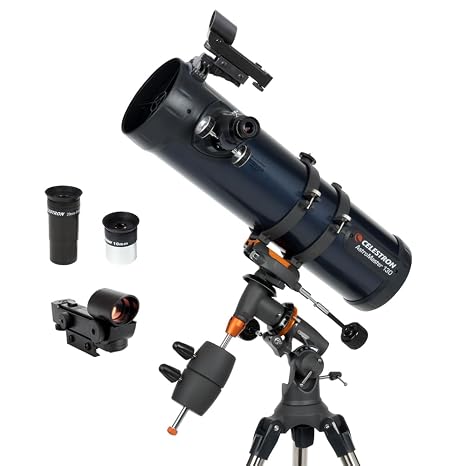
Sharp optics and a powerful 130mm aperture make this telescope well-suited for beginners ready to explore deep space. Its equatorial mount stands out by offering smooth and accurate manual control for easy tracking of celestial objects.
Setup is straightforward, with clear manual adjustments allowing precise aiming through its slow-motion control knobs. The built-in StarPointer™ red dot finderscope simplifies locating targets, while compatibility with iPhone, iPad, and Android devices adds a helpful digital touch during observation sessions.
Images through the 130mm Newtonian reflector are clear and bright, thanks to high-quality aluminum and SiO₂ coatings. The solid equatorial mount provides steady support for stable viewing. A noted downside is the need for manual focus, which may require patience when fine-tuning.
Users appreciate the balance between optical quality and ease of use for viewing galaxies and planets.
Sharp, bright images are a consistent highlight, supported by coatings on the mirrors that improve light collection. Many find that manual focus demands patience, especially during nighttime observations when conditions vary. The mount provides stability but users need to adjust controls steadily for accurate tracking.
Anyone starting with astronomy and wanting to see galaxies clearly will appreciate the cost-to-performance ratio. Those looking for automatic tracking or easier focusing may want to look at other models. The telescope suits hands-on users ready to learn manual controls and get familiar with equatorial mounts.
Pros
- High-quality optics with effective light gathering
- Smooth slow-motion control knobs for precise aiming
- Stable equatorial mount ensures steady views
- Compatible with smartphones for enhanced viewing
Cons
- Manual focusing can be challenging for new users
- Not battery powered and requires careful handling
| Specification | Details |
|---|---|
| Optics | 130mm Newtonian reflector with aluminum and SiO₂ coatings |
| Mount | Equatorial Mount |
| Eyepiece | Standard 10mm |
| Focal Length | 650 millimeters |
| Finderscope | StarPointer™ red dot |
| Zoom Ratio | 90 multiplier x |
13. Dwarf Mini Portable Astronomy Telescope

Ideal for stargazers on the move, this pocket-sized telescope weighs just 1.85 lbs, making it perfect for backpacking or camping trips. Its standout feature is the app-controlled system with built-in sky atlas, letting you locate distant galaxies without fuss.
Great for those who want easy setup and digital guidance over complicated optics.
Getting started takes around three minutes, thanks to the DWARFLAB App’s intuitive star map. The telescope’s compact design fits neatly in a large pocket, so carrying it around is simple. You can manually or automatically focus and use the smartphone interface to select celestial targets.
The 360° pivot freedom and Auto GOTO feature help track objects smoothly without constant adjustments.
Performance is solid for its size, with a 150 mm focal length and decent field of view that helps capture detailed galaxy images. The build is lightweight but sturdy enough for outdoor use.
Most praise highlights the easy app control and portability, while some users mention the basic anti-reflection coating could be better for crystal-clear views.
The app control and compact design receive the most praise for making galaxy viewing straightforward and convenient while carrying minimal gear. The common complaint centers on the basic anti-reflection coating, which can affect image sharpness in darker skies.
Those who want a lightweight and easy-to-use telescope for travel and casual galaxy spotting will find this meets their needs. People seeking the clearest possible images or advanced optics may want to consider other models with superior coatings and features.
Pros
- Extremely lightweight and portable
- App provides easy navigation and target selection
- Full 360° rotation for flexible viewing angles
- Quick setup taking only a few minutes
Cons
- Basic anti-reflection coating limits image clarity
- Requires nonstandard battery included with device
| Specification | Details |
|---|---|
| Weight | 1.85 lbs (840g) |
| Focal Length | 150 mm |
| Field Of View | 2.45 degrees |
| Mount Type | Altazimuth and Equatorial Mount |
| Power Source | Battery Powered |
| Control | App-Controlled with Auto GOTO |
14. Celestron NexStar 8 SE Schmidt-Cassegrain Telescope

Viewing distant galaxies can feel out of reach without the right equipment. Perfect for amateur astronomers aiming to explore the night sky, this telescope shines in its ability to deliver bright, clear images thanks to its high-quality optics and computerized mount for easy targeting.
Setting up is straightforward with its single fork arm mount on a tripod, making it stable yet portable enough for backyard or remote observations. The included StarPointer finderscope and Starry Night SE software guide you to celestial objects with ease.
The manual focus and smartphone compatibility let you fine-tune and share your views without hassle.
The 8 Schmidt-Cassegrain lens captures stunning detail with StarBright XLT coatings that improve light transmission. It’s solidly built but not overly heavy, suited for serious use without being cumbersome.
Users often praise its precise automated tracking but sometimes mention the need for multiple batteries and occasional manual adjustments for sharp focus.
Bright, detailed views and automated tracking stand out as the best features, enabling users to easily find and observe celestial bodies. A common complaint is the dependence on 8 nonstandard batteries, which can be inconvenient during extended sessions.
This setup suits those excited about regular, guided sky observation who want a balanced mix of power and portability. Anyone seeking a simpler model without many batteries or fully automatic focus might consider other options.
Pros
- Bright, clear images with StarBright XLT coatings
- Fully automated GoTo mount with 40,000+ objects
- Compatible with smartphones and tablets
- Includes helpful software and WiFi module
Cons
- Requires 8 nonstandard batteries for power
- Focus needs manual adjustments for sharpness
| Specification | Details |
|---|---|
| Focal Length | 406 millimeters |
| Eye Piece Lens Description | Plossl |
| Mount | Altazimuth Mount |
| Power Source | Solar Powered |
| Field Of View | 1.9 degrees |
| Zoom Ratio | 35 |
15. Celestron NexStar 8SE Schmidt-Cassegrain Telescope

With a full 8-inch aperture, the Celestron NexStar 8SE delivers excellent light gathering to reveal detailed views of faint celestial objects, including galaxies. It suits amateur astronomers looking for rich star and planet detail combined with computerized ease of use on an altazimuth mount.
Setting up involves the SkyAlign technology, which quickly gets the telescope aligned without fuss. The computerized GoTo mount and auto tracking simplify locating and following objects in the night sky. Manual focus lets you zero in precisely, while the battery power keeps it wireless.
The included accessory kit adds practical eyepieces and filters for varied viewing.
Performance is strong for deep-sky objects like galaxies and planets such as Saturn, where rings and divisions come through clearly. Sturdy StarBright XLT coatings improve image brightness and clarity.
The build feels solid but not overly heavy. Most praise centers on clear, sharp views and easy targeting. Some users mention the full setup and manual focus needing patience.
Clear, detailed views of planets and galaxies stand out, aided by the computerized positioning. The most common drawback noted involves the initial learning curve in focusing and setup, which can take some getting used to.
Astronomy enthusiasts wanting sharp planetary and deep-sky observation with tech to assist locating objects will appreciate this scope. Those needing quicker setup or less manual control might want to consider simpler or motorized focus models.
Pros
- 8-inch aperture reveals faint celestial objects
- SkyAlign simplifies telescope alignment
- Computerized GoTo mount with auto tracking
- Bundle includes eyepiece/filter accessory kit
Cons
- Manual focus requires steady hands
- Battery power limits continuous use time
| Specification | Details |
|---|---|
| Aperture | 8 inches |
| Focal Length | 2032 millimeters |
| Mount | Altazimuth Mount |
| Focus Type | manual focus |
| Power Source | battery powered |
| Finderscope | reflex |
Best Telescopes for Viewing Galaxies Compared
| Product | Aperture | Focal Length | Mount | Focus Type |
|---|---|---|---|---|
| Generic 90mm Refractor | 90mm | 600mm | Altazimuth | Manual |
| Celestron StarSense 114AZ | – | – | Altazimuth | Manual |
| Celestron NexStar 130SLT | – | – | Altazimuth | Manual |
| SVBONY SV503 ED 102mm | 102mm | 714mm | Tripod | Manual |
| Celestron StarSense DX 130AZ | – | – | Altazimuth | Manual |
| Generic 90mm 800mm Refractor A | 90mm | 800mm | Altazimuth | Manual |
| Generic 90mm 800mm Refractor B | 90mm | 800mm | Equatorial | Manual |
| Generic 150EQ Newtonian | 150mm | 650mm | Equatorial | Manual |
| ZWO Seestar S30 Pro | – | – | Altazimuth | Auto and Manual |
| Generic 70mm Refractor | 70mm | 400mm | Altazimuth | Manual |
| Generic Auto-focus Digital Telescope | – | 300mm | Tripod | Auto |
| Celestron AstroMaster 130EQ | – | – | Equatorial | Manual |
| Dwarf Mini Portable Telescope | – | 150mm | Altazimuth and Equatorial | Manual and Auto |
| Celestron NexStar 8 SE | – | 406mm | Altazimuth | Manual |
| Celestron NexStar 8SE | – | 2032mm | Altazimuth | Manual |
- Aperture90mm
- Focal Length600mm
- MountAltazimuth
- Focus TypeManual
- Aperture–
- Focal Length–
- MountAltazimuth
- Focus TypeManual
- Aperture–
- Focal Length–
- MountAltazimuth
- Focus TypeManual
- Aperture102mm
- Focal Length714mm
- MountTripod
- Focus TypeManual
- Aperture–
- Focal Length–
- MountAltazimuth
- Focus TypeManual
- Aperture90mm
- Focal Length800mm
- MountAltazimuth
- Focus TypeManual
- Aperture90mm
- Focal Length800mm
- MountEquatorial
- Focus TypeManual
- Aperture150mm
- Focal Length650mm
- MountEquatorial
- Focus TypeManual
- Aperture–
- Focal Length–
- MountAltazimuth
- Focus TypeAuto and Manual
- Aperture70mm
- Focal Length400mm
- MountAltazimuth
- Focus TypeManual
- Aperture–
- Focal Length300mm
- MountTripod
- Focus TypeAuto
- Aperture–
- Focal Length–
- MountEquatorial
- Focus TypeManual
- Aperture–
- Focal Length150mm
- MountAltazimuth and Equatorial
- Focus TypeManual and Auto
- Aperture–
- Focal Length406mm
- MountAltazimuth
- Focus TypeManual
- Aperture–
- Focal Length2032mm
- MountAltazimuth
- Focus TypeManual
How to Choose the Best Telescope for Galaxies
Choosing the right telescope for viewing galaxies means focusing on factors like aperture size and light-gathering ability, which determine how clearly faint objects appear. Prioritizing these features helps avoid frustration and extra costs by ensuring the telescope meets the demanding needs of deep-sky observation.
Aperture Size
Using a telescope with a small aperture is like trying to see stars through a foggy window. The amount of light the lens or mirror collects directly affects how bright and clear galaxies appear. Smaller apertures struggle to show faint details and can make galaxies look dim and washed out.
Many experienced stargazers find that starting around 6 inches (150mm) in diameter offers a sensible balance. These sizes allow enough light to reveal more structure in distant celestial objects without making the instrument too bulky.
Very large apertures over 10 inches improve light gathering even more but quickly become heavy and hard to move around.
Balancing aperture with portability is essential for practical use. A nearly 8-inch model often hits a sweet spot where image quality noticeably improves, yet the telescope remains manageable for night trips to dark sites.
Users who overlook this can end up with either poor views or a setup that’s impractical to handle regularly.
Optical Quality
The sharpness and contrast of what you see through a telescope depend heavily on the quality of its lenses or mirrors. Low-quality glass creates blurry or washed-out images that frustrate attempts to study faint objects. Well-made optics use special coatings to minimize glare and boost light transmission, improving clarity significantly.
Spotting faint galaxy arms or small star clusters becomes easier with proper coatings.
Collimation, which means precise alignment of mirrors or lenses, also plays a critical role. Even a slight misalignment can blur details quickly, making faint objects disappear into the background. Regular users know to check and adjust this often.
Good telescopes either hold collimation well or provide simple tools for tuning the setup without hassle. Spending extra on optics with these traits pays off in better, more reliable views every session.
Mount Stability and Tracking
Trying to observe faint galaxies is difficult without a stable mount. Even minor vibrations from wind or touching the telescope are amplified at high magnifications, turning crystalline views into jittery messes. Solid construction and heavy tripods reduce this problem significantly.
Equatorial or motorized mounts make following celestial objects easier, as the Earth’s rotation moves them across the sky steadily.
Manual mounts require frequent nudges that disrupt focus and patience, but those with motors keep the target centered longer. Setup time also affects how often a telescope gets used; mounts that lock easily into place without complicated calibration save frustration.
Long observation sessions are far more enjoyable when the telescope stays steady and tracks the sky smoothly.
Portability and Size
Trying to drag a large, heavy telescope out to remote dark sky locations often discourages observation plans. Weight and size matter because they affect how and where the instrument can be taken.
Many galaxy viewers prefer compact models that break down into manageable parts or fold into smaller sizes. Carrying cases or backpacks designed for the telescope protect delicate parts during transport and storage.
Space inside the home or vehicle also limits choices. A 10-inch scope sitting permanently at home might offer great views but rarely leaves the backyard, which can have light pollution issues. Smaller, portable designs encourage more frequent outings to darker skies where faint structures become visible.
Weighing these factors realistically helps avoid expensive gear collecting dust.
Eyepiece Compatibility and Magnification
Having a range of compatible eyepieces expands what can be seen through a telescope. Low-power eyepieces provide wider views to locate galaxies, while higher magnifications help in resolving structural details. Still, pushing magnification too high without ample aperture or stable conditions just yields dim, blurry images rather than enhancements.
Swapping eyepieces quickly and securely during a session improves flexibility when tracking different objects or adjusting to changing sky conditions. Telescopes using standard barrel sizes (like 1.25-inch) offer broad compatibility with many aftermarket eyepieces.
People with equipment that lacks easy swapping features or has limited eyepiece options often find their observing sessions less rewarding.
Tips for Optimizing Galaxy Viewing with Your Telescope
Galaxies appear as faint, diffuse objects through any amateur telescope, so getting the best view depends heavily on preparation and conditions. Choose a night with clear, dark skies away from city lights. Light pollution can wash out the subtle details that make galaxy viewing rewarding.
Use these tips to improve your galaxy observations:
- Allow your telescope to cool down for at least 15 minutes outside; this reduces internal air currents that blur the image.
- Start with a low-power eyepiece to find the galaxy, then switch to higher magnification for details.
- Use a star chart or an astronomy app to locate galaxies accurately; they often require precise pointing outside bright constellations.
- Avoid using the telescope on nights with a bright moon since its light reduces contrast and visibility of faint galaxies.
Regularly cleaning the optics and checking collimation also maintains optimal performance. Consistency with these habits leads to clearer, more satisfying galaxy views.
Comparing Reflector and Refractor Telescopes for Deep Space Observation
Reflector and refractor telescopes differ significantly in construction, influencing their suitability for deep space observation. Reflectors use mirrors to gather light, often providing larger apertures at a lower cost.
This makes them good at collecting the faint light from distant galaxies.
Refractors rely on lenses and typically offer sharper, contrasty images with less maintenance, since they don’t need alignment (collimation) as often. However, they tend to be more expensive per inch of aperture.
Consider the following for galaxy viewing:
- Reflectors usually give you more light-gathering power for the price, important when targeting faint deep-sky objects.
- Refractors provide cleaner views of brighter objects but might struggle with dim galaxies unless they have a large aperture.
- Reflectors may need more upkeep, including occasional mirror adjustments to keep the image sharp.
- Weight and portability also differ; refractors are generally more compact and rugged.
Choose based on your priorities: aperture size and budget favor reflectors, while ease of use and crisp optics lean toward refractors.
People Also Asked
How Do I Properly Clean and Maintain My Galaxy Telescope?
Use a soft brush or air blower to gently remove dust from the lenses and mirrors. Avoid touching the glass with your fingers because oils can cause damage. Store the telescope in a dry, dust-free place to prevent moisture buildup that could lead to mold or corrosion.
What Size Telescope Is Ideal for Viewing Distant Galaxies Clearly?
A telescope with an aperture of at least 6 inches is usually needed to see faint galaxies clearly. Larger apertures gather more light, improving detail and brightness. Make sure to balance size with portability since bigger scopes can be heavy and harder to set up.
Are There Safety Precautions When Using a Telescope at Night?
Keep flashlights dim and use red filters on them to protect your night vision. Avoid shining the telescope near streetlights or bright sources that can disrupt your view. Also, be mindful of uneven ground to prevent tripping or equipment damage during setup or adjustments.
How Long Does a Typical Telescope Last with Regular Use?
Telescopes can last many years, often decades, if maintained properly. Regularly cleaning optics and checking for loose parts helps extend their lifespan. Mechanical parts like mounts may require occasional lubrication or tightening for smooth operation.
What Common Problems Should I Expect with a Galaxy-Viewing Telescope?
Collimation issues, where mirrors are misaligned, are common and affect image quality. Power supply and battery problems can disrupt electronic mounts or tracking systems. Cleaning optics carefully and checking alignment before each session saves frustration during observations.
Conclusion
Choosing a telescope for viewing galaxies mainly depends on aperture size since bigger lenses gather more light for clearer views. A stable mount is important to keep the telescope steady when looking at faint objects.
Also, consider the portability of the telescope if you plan to move it to different locations for darker skies.
Think about where you will use the telescope and how often. A small, easy-to-transport model suits occasional use, while a larger, more complex setup fits serious observing but needs dedicated space. Check the comparison table and detailed sections above for options that match your needs and budget before making a decision.