Top 15 Best Monocular for Long Distance You Can’t Miss!
Squinting through a cheap monocular trying to spot a distant bird or landmark often ends with a blurry or shaky view. The best monocular for long distance avoids these frustrations by providing clear, stable images even far away.
Using one that lacks proper zoom or optical quality can make outdoor activities like hiking or wildlife watching less enjoyable and more tiring.
Key features that define a good long-distance monocular include optical magnification, lens coating, and build quality. Typically, magnification between 8x and 12x strikes a balance between zoom and stability. Fully multi-coated lenses improve light transmission, making distant objects clearer in low light.
A durable, waterproof body protects the device in harsh conditions, while a compact size ensures it’s easy to carry and use for extended periods.
Need a Quick Check?
| Image | Product | Price |
|---|---|---|
Our Top Picks 1  | Vortex Solo 10×36 | Check Price |
Our Top Picks 2  | Generic 80×100 Monocular | Check Price |
Our Top Picks 3  | 12×56 Monocular Phone Mount | Check Price |
Our Selected Top 15 Monocular for Long Distance You Can Trust
This list features carefully chosen monoculars designed for clear, long-distance viewing. Each review explains how well it performs, who it is best suited for, and highlights its main advantages and drawbacks to help you make an informed decision.
1. Vortex Solo Monocular 10×36
Vortex Solo Monocular 10×36 provides clear, detailed views for long-distance observation, ideal for outdoor enthusiasts who need a lightweight and durable optic. Its best feature is the combination of 10x magnification with crisp resolution, making distant scenes easy to see without bulk.
Everyday use is straightforward thanks to its small, lightweight design that fits comfortably in hand. Setting it up takes seconds, with an adjustable eyecup for comfortable viewing with or without glasses. The rubber armor ensures it feels secure to hold, even in wet conditions, while the multi-position clip keeps it conveniently attached to gear or clothing.
The image clarity at 10x power stands out, delivering bright views with 36mm lenses that handle light well. It feels solid and tough, supported by waterproof and fogproof construction sealed with O-rings and nitrogen purging. Reviews commonly highlight durability and grip as strong points, while some mention the field of view could be wider.
Image quality and durability receive frequent praise, thanks to bright, sharp views and solid waterproof construction. Many appreciate the grip provided by the rubber armor even in adverse weather. However, several users point out the field of view is somewhat limited for scanning wide areas.
People who want a dependable monocular for spotting distant objects will find this design fits well, especially in outdoor or active settings. Those who want a wider field of view for quick outdoor scanning might find other options better suited for that purpose.
Pros
- Clear 10x magnification with bright images
- Lightweight and easy to carry
- Durable, non-slip rubber armor
- Waterproof and fogproof for all conditions
Cons
- Narrower field of view than some competitors
- Multi-position clip can feel bulky
| Specification | Details |
|---|---|
| Magnification | 10x |
| Objective Lens Diameter | 36mm |
| Lens Coating | Fully Multi-Coated |
| Waterproof/Fogproof | Yes, Nitrogen Purged and O-ring Sealed |
| Body Armor | Fully Rubber Armored |
| Eyecup | Adjustable |
2. Monocular Telescope 80×100
Handling this monocular feels surprisingly natural for such a powerful device. Perfect for anyone wanting detailed long-distance views, it stands out for delivering clear and bright images even in varying outdoor light conditions.
Setup is simple, with a compact design that easily fits into a small bag or pocket. Gripping it feels comfortable during hikes or sightseeing trips, letting you focus on the scene without fumbling.
Its lightweight design ensures it won’t weigh you down, making daily use easy and comfortable.
The image clarity is impressive thanks to high-quality lenses and multi-layer coatings reducing reflections and boosting light transmission. The construction is solid but still travel-friendly. Many appreciate how sharply it captures distant objects, though some mention it could feel a bit delicate in rough weather.
Sharp and detailed views are the main highlight, thanks to advanced coatings that cut down glare and boost light. Users often note the monocular’s lightweight build makes it easy to carry but mention concerns about durability in tough environments.
Great for nature watchers and travelers who prioritize optical clarity and portability. Those needing a rugged or waterproof model might want to explore other options better suited for harsh conditions.
Pros
- Clear and bright images even in low light
- Compact size fits easily in backpacks
- Comfortable ergonomic grip for extended use
- Effective at reducing glare and reflections
Cons
- Feels somewhat fragile in harsh outdoor conditions
- Not ideal for rough handling or wet weather
| Specification | Details |
|---|---|
| Magnification | 80×100 |
| Optical lenses | High-quality with multi-layer coatings |
| Design | Compact and lightweight |
| Suitable for | Hiking, camping, sightseeing |
3. 12×56 Monocular with Phone Adapter
Great for anyone wanting detailed views over long distances, this 12×56 monocular puts impressive power in a compact form. It suits outdoor lovers who need sharp images without lugging around binoculars, with its clear optics standing out as its strongest feature.
Setting up involves simply turning the center focus wheel to sharpen the image, which is straightforward and user-friendly. The 21mm large eyepiece makes looking through comfortable for extended periods, while the 56mm objective lens brightens the view. It’s easy to carry and perfect for quick spotting during wildlife watching or birding trips.
The monocular delivers bright and detailed views at 12 times magnification, making distant objects crisp and easy to see. Built for adults, it balances power and portability well.
Most praise focuses on its clarity and sharpness, though some mention that a wider field of view isn’t available since it’s a monocular, not binoculars.
Users find the image clarity and brightness impressive at 12x zoom. Some note the field of view is limited, which is expected in a monocular design, and focusing demands patience for sharpness.
Those wanting a powerful, portable device for birdwatching or wildlife will be satisfied. People needing wide panoramic views should consider binoculars instead.
Pros
- Sharp, detailed long-distance viewing
- Comfortable 21mm large eyepiece
- Compact and portable alternative to binoculars
- Easy manual focus adjustment
Cons
- Narrower field of view than binoculars
- Requires slow focusing for best clarity
| Specification | Details |
|---|---|
| Magnification | 12x |
| Objective Lens Diameter | 56mm |
| Eyepiece Diameter | 21mm |
| Focus Method | Center focus wheel |
4. Monocular Telescope 80×100 with Smartphone Adapter

Durable materials and a large 100mm objective lens make this monocular telescope a solid choice for anyone needing powerful long-distance viewing. The 80x magnification stands out, ideal for birdwatchers or wildlife spotters who want clear detail from far away.
Setting up the monocular is straightforward, especially with the included smartphone adapter for snapping distant shots. The large lens gathers ample light, making images bright even in varied outdoor conditions.
Handling feels balanced and stable, helping keep the view clear during extended use without tiring your hand.
The 80x magnification delivers impressive detail on distant objects, while the BAK4 prism ensures good light transmission and image clarity. The body feels well-built and suited for outdoor adventures.
Some users mention the size and weight can feel a bit bulky for quick, casual use, but those focused on quality steady viewing mostly praise its performance.
Most praise centers on the clear, bright images at high magnification thanks to the large lens and BAK4 prism. The common complaint involves its bulk, which some find a bit heavy for casual handheld use.
People wanting detailed long-range views and willing to handle a slightly heavier monocular will appreciate this model. Those needing something ultra-compact or lightweight for quick trips might look for a smaller, less powerful option.
Pros
- High 80x magnification for detailed long-distance views
- Large 100mm lens captures more light effectively
- Includes smartphone adapter for easy photos
- BAK4 prism improves image brightness and sharpness
Cons
- Bulky size may be cumbersome for casual carry
- Weight can cause hand fatigue during extended use
| Specification | Details |
|---|---|
| Magnification | 80x |
| Objective Lens Diameter | 100mm |
| Prism Type | BAK4 |
| Optical Quality | High-quality optical components |
| Additional Feature | Smartphone Adapter |
5. 12×60 Monocular Telescope

12× magnification stands out the most, making it easy to spot distant objects clearly, which makes it a solid choice for outdoor enthusiasts. Ideal for people who enjoy hiking, bird watching, or attending events where seeing far away is important.
Setting it up is straightforward since it doesn’t have complex parts to fuss with. The 60mm objective lens lets in plenty of light, so viewing in different lighting conditions stays bright enough.
The large 21mm BAK-4 prism helps you keep sharp images without much eye strain during long use.
Image clarity holds up well thanks to the quality lens and prism system, giving crisp views with minimal color distortion. The build feels sturdy for a handheld monocular, though some users mention it can feel a bit heavy to carry all day. Strong vision performance easily makes up for that minor downside.
Clarity and brightness stand out as the monocular’s biggest strengths, especially in daylight. Users appreciate the vivid and sharp images without color issues. However, a common complaint is the weight, which can tire the arm during extended viewing sessions or long hikes.
People who focus on clear, detailed views over long distances will be satisfied with its performance. Those needing something lightweight or fully weather-resistant might want to explore other options suited for tough outdoor environments or longer handheld use.
Pros
- Bright, clear images with minimal distortion
- Wide field of view for covering large areas
- Simple and quick to focus
- Good for various outdoor activities
Cons
- Somewhat heavy for extended handheld use
- Not waterproof or fog-proof
| Specification | Details |
|---|---|
| Magnification | 12× |
| Objective Lens Diameter | 60 mm |
| Field of View | 6.5° (325 ft/1000 yd) |
| Prism Type | 21mm BAK-4 |
6. Gosky 12×55 HD Monocular

Great for anyone needing detailed views at long distances, this monocular offers impressive 12x magnification paired with a wide field of view. It suits bird watchers, travelers, and outdoor enthusiasts who want crisp visuals without lugging bulky gear.
Setting it up requires no fuss; simply adjust the focus ring to sharpen images. The large 55mm objective lens makes it easy to see in varying light conditions, while its balanced weight ensures comfortable handheld use during extended outings. Keeping it clean is straightforward thanks to the lens coating, making it resilient against smudges and dust in daily adventures.
Long-range viewing is clear and bright thanks to the 12x magnification combined with a 352 ft wide viewing area at 1,000 yards. The build feels solid and durable, meeting expectations for outdoor gear without being too heavy.
Most users praise the sharp image quality, while the main drawback noted is that some find the focus ring a bit stiff when adjusting quickly.
The clear and sharp imagery combined with wide viewing helps users spot and follow targets easily in daylight. The main downside is the somewhat stiff focus ring, which can slow quick adjustments during fast-moving scenes.
Those wanting bright, long-distance views and comfortable handling will appreciate this monocular. People needing ultra-light or faster focusing optics might look at other options better suited for rapid movements or minimalist carry.
Pros
- 12x magnification for detailed distant views
- Wide 352 ft field of view for easier tracking
- Large 55mm objective lens brightens images
- Good balance for handheld comfort
Cons
- Focus ring can feel stiff to adjust quickly
- May be bulky for very lightweight carry needs
| Specification | Details |
|---|---|
| Magnification | 12x |
| Objective Lens Diameter | 55mm |
| Field of View | 352 ft @ 1,000 yds |
| Exit Pupil | 4.58mm |
7. 8×42 High Power Monocular
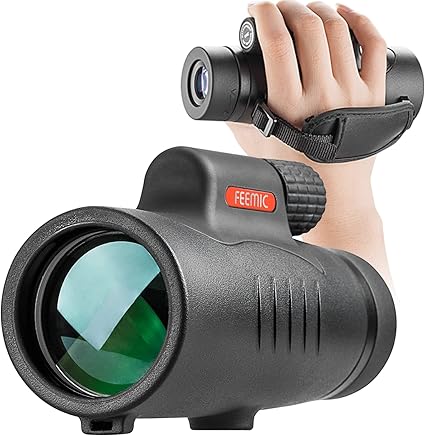
Watching nature or spotting distant landmarks can be tricky without proper magnification. Designed for outdoor lovers and adventure seekers, this monocular stands out for its wide-angle HD view and sharp 8X magnification, making long-distance observation clearer and more immersive.
Setting it up takes no time, thanks to a simple design and protective features like a built-in lens dust cover. The rubber coating provides a solid grip and absorbs shocks during outdoor use.
Carrying it around for hiking or birdwatching feels secure, and the waterproof, fogproof, and dustproof construction keeps your view clear in changing weather.
Optics deliver bright, detailed images across a large field of view, helping you catch distant details with ease. The housing feels rugged enough to handle rough conditions without damage.
Most praise centers on how clear and wide the vision is. A few note that the size can feel a bit bulky during extended carries.
Bright and detailed images combined with a wide-angle view rank as its best features. The solid, weather-resistant build does well outdoors, though some find its bulk a drawback when held for a long time. The lens cover protects well but slows quick adjustments.
Those who want sharp, broad views during outdoor adventures will appreciate it. People needing a lighter, more compact monocular might want to look elsewhere for easier all-day carry options.
Pros
- Wide 360ft field of view at 1000 yards
- Durable rubber finish for shock resistance
- Waterproof and fogproof for all weather use
- High-end optics with BAK-4 prism clarity
Cons
- Feels bulky for long periods of handheld use
- Lens cover may be inconvenient during quick viewing
| Specification | Details |
|---|---|
| Magnification | 8X |
| Objective Diameter | 42mm |
| Field of View | 360ft/1000yards |
| Prism Type | FMC Superior BAK-4 Green Film Prism |
| Waterproof | Nitrogen-filled waterproof |
8. TOPDON TS004 Thermal Imaging Monocular

Boasting a high IR resolution of 256×192 and an 8x zoom, this thermal monocular suits long-distance spotting in low visibility conditions. Its biggest strength lies in delivering vivid thermal images with precise detail, making it a solid choice for outdoor adventures or wildlife observation at night.
Setup involves a manual focus system and one lithium-ion battery included, providing up to 11 hours of continuous use so you won’t find yourself cutting your exploration short. Pairing it with a smartphone through the TopInfrared App allows for real-time monitoring, a handy feature when keeping track of moving targets or sharing views. The 13.5-degree field of view balances between wide coverage and detail.
Performance shines with a smooth 50Hz refresh rate that keeps the image fluid during motion and a monocentric eyepiece lens designed for clear thermal imaging. The housing feels sturdy and well-built, suited for outdoor conditions without feeling bulky. Most praise goes toward its long battery life, while some mention that manual focus requires steady hands and attention to maintain clarity.
Long battery life and clear heat images stand out as the main advantages, but some users find the manual focus challenging to use smoothly, especially when trying to lock onto distant or moving objects. The wireless connection with a smartphone adds convenience during active observation.
People looking for extended use in the field and a solid thermal picture will appreciate this monocular. Those wanting a wider view or easier focusing might want to explore alternatives with automatic focus or broader fields of view.
Pros
- Clear thermal images with high IR resolution
- Extended 11-hour battery life
- Wireless phone connectivity for live monitoring
- Compact and durable design for outdoor use
Cons
- Manual focus can be tricky without steady hands
- Limited field of view at 13.5 degrees
| Specification | Details |
|---|---|
| IR Resolution | 256×192 |
| Battery | 1 Lithium Ion battery (included), 5000mAh |
| Zoom Ratio | 8x |
| Field Of View | 13.5 degrees |
| Focus Type | manual focus |
| Eye Piece Lens Description | Monocentric |
9. 12×56 Monocular Telescope with Smartphone Adapter

Bird watchers, hikers, or anyone who wants a close, clear look at distant scenes will find the 12×56 Monocular Telescope with Smartphone Adapter a solid choice. Its standout feature is the 12X magnification combined with a wide 6.5° field of view, making faraway details easier to see without feeling cramped.
Setting it up is straightforward, and the large 25mm eyepiece paired with the 56mm objective lens means more light comes in, which keeps images bright and sharp even in less-than-ideal lighting. The included smartphone adapter is handy for snapping photos or videos of what you’re viewing without fuss.
Carrying it along feels comfortable during outdoor activities because the wide-angle view avoids constant repositioning.
Performance aligns well with what the specs suggest, seeing details at distances up to about 1200 yards is impressive for such a compact monocular. The build quality lets you expect some durability, though it doesn’t claim waterproof or shock-resistant features.
The most praised part is how bright and clear the image stays over distance. The primary drawback mentioned is that it can be a bit bulky compared to smaller monoculars.
Brightness and clarity stand out as the strongest points, letting users enjoy detailed views without dimming. Bulkiness is the most frequent complaint, as some find it less convenient to carry around compared to smaller monoculars.
Anyone prioritizing clear, bright, long-distance viewing will appreciate its features, especially with the smartphone adapter included. People who want something light and easy to pocket should look at more compact options.
Pros
- Bright and clear images even from far away
- Wide 6.5° field of view reduces eye strain
- Large lenses allow more light for sharpness
- Smartphone adapter captures views easily
Cons
- Noticeably heavier and bulkier than some models
- No waterproof or shockproof rating provided
| Specification | Details |
|---|---|
| Magnification | 12X |
| Field of View | 6.5° wide angle |
| Eyepiece Size | 25mm |
| Objective Lens Diameter | 56mm |
| Max Viewing Distance | 325ft/1200yds |
10. Gosky 15×52 Monocular with Tripod

Highly detailed views make this monocular a solid pick for spotting distant wildlife and scenery. It suits bird watchers and hunters looking for strong long-range clarity combined with stability.
The standout feature is the sharp 15x magnification paired with a 52mm lens, which keeps faraway subjects clear and close.
Setup is simple and flexible thanks to its lightweight design at 0.87 lb, letting you hold it steady with one hand or mount it on the included tripod for longer viewing sessions. The smooth focus ring helps you quickly lock onto your target without fumbling, whether scanning fast or settling in for slow observation.
Optical quality is impressive due to the BAK4 prism and FMC coatings that brighten the image and cut down glare, which keeps views crisp from daylight into dusk. The build feels solid but not bulky, making it easy to carry. Sharpness and light transmission receive a lot of praise, while some find the fixed tripod mount limiting in flexible terrain.
Users appreciate the bright and clear images even in low light thanks to the quality coatings and prism design. The included tripod helps reduce shake during extended observation, which many find indispensable. A common point of frustration is the tripod mount’s limited adjustment, making some angles awkward to achieve.
Anyone wanting a balance of strong magnification and portability will find this monocular fits the bill. It’s ideal for those focusing on birds or distant wildlife in fairly stable conditions. It may not suit people who need quick, flexible tripod positioning or prefer a bulkier grip for extra comfort.
Pros
- Bright views reduce glare and reflections
- Lightweight for easy hand-held use
- Tripod included for steady long viewing
- Smooth focus ring for quick adjustments
Cons
- Tripod mount restricts flexible positioning
- Some find the grip a bit small
| Specification | Details |
|---|---|
| Magnification | 15X |
| Objective Lens Diameter | 52mm |
| Field of View | 252 ft/1000 yds |
| Prism Type | 19mm BAK4 |
| Weight | 0.87 lb |
11. 40×60 Monocular Telescope with Tripod

40×60 Monocular Telescope with Tripod brings strong 40x magnification and a wide 40mm lens to anyone needing to see far distances clearly. Well suited for outdoor enthusiasts, it’s especially good when you want to view wide scenes and details miles away without lugging around heavy gear.
Its most notable strength is the sharp image quality thanks to premium optics.
Setting it up is straightforward, especially with the included tripod which gives good stability on uneven ground. The large 40mm objective lens captures plenty of light, making it easier to see in different lighting conditions. Dual focus lets you quickly dial in crisp views whether you’re scanning vast landscapes or zooming in on specific targets across great distances.
The BAK-4 prism and Fully Multi-Coated lens work together to deliver clear and bright images with reduced glare and reflections. The build feels solid though it’s not exactly ultra-light. The best praise centers on its sharp, far-reaching views, but a common drawback mentioned is that it may feel bulky to carry without the tripod.
Users appreciate the clear and vivid images provided by the high-quality BAK-4 prism and fully multi-coated lenses, which increase light transmission and reduce glare. On the downside, the monocular is noted to be a bit heavy and cumbersome when not mounted on the tripod, which can be inconvenient during handheld use or long treks.
This monocular suits anyone looking for impressive long-distance views with stable setup options, especially when weight is not a critical concern. People needing a lighter or more pocketable scope might look for smaller alternatives, but those prioritizing image clarity and reach will find it well worth it.
Pros
- Sharp, clear image from FMC and BAK-4 optics
- Stable viewing with included tripod
- Good field of view for long-distance spotting
- Dual focus allows precise detail adjustments
Cons
- Somewhat bulky without tripod support
- May need careful adjustment to maintain focus
| Specification | Details |
|---|---|
| Magnification | 40x |
| Objective Lens Diameter | 40mm |
| Field of View | 419ft/1000yds (128m/1000m) |
| Optics | FMC Broadband coating, BAK-4 prism |
| Focus Type | Dual Focus |
12. Monocular Telescope 80×100 with Tripod

Using this monocular feels like having a powerful telescope packed into a compact device that works great for anyone needing clear, long-distance views. Its standout feature is the impressive 80X magnification paired with a large lens, making faraway details come alive for bird watchers, travelers, or anyone observing wildlife.
Setup involves attaching the monocular to its tripod, which adds stability during use and helps keep images sharp. The design allows you to hold and adjust it comfortably with one hand, thanks to its ergonomic build.
The multi-coated lens reduces glare and makes the view bright and clear through a sturdy BAK4 prism. It’s easy to carry along on hikes or outdoor trips without feeling bulky.
It delivers bright and high-definition views with good color accuracy, handling the long-distance focus well without too much fuzziness. Built solidly with quality materials, it withstands outdoor conditions fairly well, though some users have noted it can get a bit heavy during extended use. The tripod is helpful but not always as steady on uneven ground.
Clear, bright views with strong magnification is praised by most, making it ideal for detailed, distant observation. The most common issue is the weight, which can become tiring when carrying or holding the monocular for long periods. The tripod helps but isn’t perfect for every terrain.
Those who want a powerful device for hiking, birdwatching, or travel outdoors will appreciate the sharp imagery and wide views. Users needing something lighter or with a more stable base on rough ground might want to explore other options.
Pros
- Bright, clear image with true color
- Comfortable one-handed use design
- Stable tripod included for steady viewing
- Wide field of view for detailed observation
Cons
- Can feel heavy during long use
- Tripod stability less reliable on uneven surfaces
| Specification | Details |
|---|---|
| Magnification Power | 80X |
| Objective Lens Diameter | 100mm |
| Lens Type | FMC multi-coated lens |
| Prism Material | BAK4 prism |
| Included Accessories | Tripod |
13. Bushnell Legend 10×42 Monocular

Bushnell Legend 10×42 Monocular offers sharp long-distance viewing with solid durability. Suited for outdoor enthusiasts like birdwatchers, hunters, or those needing a clear view at 10x magnification, it stands out for its clear optics that don’t falter in low light. It’s compact enough to carry around without bulk.
Setting up the monocular is straightforward thanks to its manual focus and tripod mount compatibility. The rubber-armored exterior gives a good grip, even in wet or tough conditions. Battery power supports the finderscope, and its rugged, waterproof design means it handles rain or fog without losing image clarity.
Optics deliver clear, vibrant images due to ED Prime glass and Ultra Wide Band Coating. The field of view covers 340 feet, ensuring precise detail at a distance.
It’s well-built to resist weather and rough handling. The main praise is its sharp image quality, while a common gripe relates to its reliance on a battery for the finderscope which can be inconvenient.
Sharp image quality and weather resistance are consistently praised, making views detailed and vivid even in low light. The common issue is reliance on a battery for the finderscope, which some find inconvenient during extended use.
People who want clear, reliable optics in various outdoor conditions will appreciate this monocular. Those looking for fully battery-free or autofocus options might look elsewhere.
Pros
- Clear optics with advanced ED Prime glass
- Waterproof and fog proof design
- Rubber-armored for durable grip
- Compact and easy to carry
Cons
- Requires battery for finderscope operation
- Manual focus may need frequent adjustment
| Specification | Details |
|---|---|
| Magnification | 10x |
| Objective Lens Diameter | 42 mm |
| Field of View | 340 feet |
| Focus Type | Manual Focus |
| Waterproof | Yes |
| Power Source | 1 12V battery |
14. 40×60 Monocular Telescope with Phone Adapter

Made with a sturdy design and featuring a 40×60 magnification, this monocular telescope fits well for outdoor enthusiasts, from adults to kids. Its standout feature is the ability to deliver clear, bright images thanks to the large objective lens and quality optics, making it great for bird watching, hiking, or traveling.
Setting up the monocular is straightforward, and using it day-to-day is simple with the included phone adapter for capturing distant sights. The fully multi-coated BAK 4 prism lens ensures the image stays sharp, even in varying light conditions.
Its compact size also makes it easy to carry around, while the waterproof and fog-proof body provides confidence during unpredictable weather.
Performance excels with high contrast images and no black bars, providing sharp views from long distances. The build has a solid feel and withstands rough outdoor use well. The clearest praise highlights excellent image clarity, while the most common grip is about the need for steady hands to keep the image stable due to high magnification.
Clear, bright images are consistently noted as the best feature, with impressive sharpness and no blackout bars. A common downside is the need for a steady grip at 40x magnification to avoid shaking and blurry views, which takes practice or a tripod.
People who like outdoor exploration and want to observe wildlife or landscapes from a distance will appreciate this monocular’s clarity and rugged design. Those prioritizing ultra-compact size or easy one-hand use might look for a smaller or lower magnification alternative.
Pros
- Clear and sharp images with high contrast
- Durable waterproof and fog-proof body
- Large 60mm objective lens for bright views
- Comes with a phone adapter for easy photo capture
Cons
- High magnification requires steady hands
- May be bulky for lightweight travel packs
| Specification | Details |
|---|---|
| Magnification | 40x |
| Objective Lens Diameter | 60mm |
| Prism Type | BAK 4 |
| Waterproof & Fog Proof | Yes, nitrogen filled |
| Phone Adapter Included | Yes |
15. 80×100 Monocular Telescope

Massive 80x magnification combined with a 100mm objective lens makes spotting distant objects impressively clear. Perfect for bird watchers or outdoor enthusiasts seeking powerful long-range viewing, it delivers sharp images even from a great distance.
Setting it up involves attaching the universal smartphone adapter, which fits most phones for snapping photos or videos at a distance. Day-to-day use centers on the fully multi-coated optical lenses that keep images bright and detailed, making it easy to track subjects without constantly adjusting focus or lighting conditions.
Performance-wise, the large lens and high magnification bring distant scenes into crisp view, great for detailed observation. The build feels solid and durable, though the size of the objective lens makes it a bit bulkier than smaller monoculars.
Users often praise the clear, bright images; the most common drawback is its heavier weight and less compact form.
Users appreciate how bright and detailed distant objects appear through the monocular’s fully multi-coated optics. At the same time, many note that its size and weight make it less convenient to carry for extended periods or in tight spaces.
Bird watchers or outdoor observers wanting high-powered zoom with exceptional clarity will be satisfied with this monocular. Those needing a lightweight, compact option for quick field use might look for a smaller, less bulky alternative.
Pros
- Sharp images with 80X magnification
- Bright views from 100mm objective lens
- Easy photo and video capture via smartphone adapter
- Fully multi-coated optics improve clarity
Cons
- Relatively heavy and less portable
- Large lens size requires careful handling
| Specification | Details |
|---|---|
| Magnification | 80X |
| Objective Lens Diameter | 100mm |
| Optical Coating | Fully Multi‑Coated |
| Smartphone Adapter | Universal, fits most models |
Comparison of Best Long Distance Monoculars
| Product | Magnification | Objective Lens Size | Field of View | Mount |
|---|---|---|---|---|
| Vortex Solo 10×36 | 10x | 36mm | – | – |
| Generic 80×100 Monocular | 80x | 100mm | – | – |
| 12×56 Monocular Phone Mount | 12x | 56mm | – | Phone Mount |
| 80×100 Monocular Smartphone | 80x | 100mm | – | – |
| 12×60 Monocular Telescope | 12x | 60mm | 325ft/1000yds | – |
| Gosky 12×55 HD | 12x | 55mm | 352ft/1000yds | – |
| 8×42 High Power | 8x | 42mm | 360ft/1000yds | – |
| TOPDON TS004 Thermal | – | 13mm | – | Equatorial Mount |
| 12×56 Phone Adapter | 12x | 56mm | 6.5° wide angle | Phone Adapter |
| Gosky 15×52 Tripod | 15x | 52mm | 252ft/1000yds | Tripod |
| 40×60 Tripod Monocular | 40x | 60mm | 419ft/1000yds | – |
| 80×100 Tripod Monocular | 80x | 100mm | Wide field | – |
| Bushnell Legend 10×42 | 10x | 42mm | – | Tripod |
| 40×60 Phone Adapter | 40x | 60mm | – | – |
| 80×100 Monocular | 80x | 100mm | – | – |
- Magnification10x
- Objective Lens Size36mm
- Field of View–
- Mount–
- Magnification80x
- Objective Lens Size100mm
- Field of View–
- Mount–
- Magnification12x
- Objective Lens Size56mm
- Field of View–
- MountPhone Mount
- Magnification80x
- Objective Lens Size100mm
- Field of View–
- Mount–
- Magnification12x
- Objective Lens Size60mm
- Field of View325ft/1000yds
- Mount–
- Magnification12x
- Objective Lens Size55mm
- Field of View352ft/1000yds
- Mount–
- Magnification8x
- Objective Lens Size42mm
- Field of View360ft/1000yds
- Mount–
- Magnification–
- Objective Lens Size13mm
- Field of View–
- MountEquatorial Mount
- Magnification12x
- Objective Lens Size56mm
- Field of View6.5° wide angle
- MountPhone Adapter
- Magnification15x
- Objective Lens Size52mm
- Field of View252ft/1000yds
- MountTripod
- Magnification40x
- Objective Lens Size60mm
- Field of View419ft/1000yds
- Mount–
- Magnification80x
- Objective Lens Size100mm
- Field of ViewWide field
- Mount–
- Magnification10x
- Objective Lens Size42mm
- Field of View–
- MountTripod
- Magnification40x
- Objective Lens Size60mm
- Field of View–
- Mount–
- Magnification80x
- Objective Lens Size100mm
- Field of View–
- Mount–
How to Choose the Right Long Distance Monocular
Choosing the right long distance monocular depends on factors like magnification, lens quality, and durability to ensure clear, sharp views from afar. Prioritizing these features helps avoid frustration and costly replacements, making your investment practical and reliable for extended use.
Magnification Power
Using a viewing device with very high zoom can turn the image into a shaky mess if held by hand, making it tough to pick out details at a distance. Operators often realize that extreme magnification narrows the field of view too much, so tracking birds or moving targets gets frustrating.
A balance around 8x to 10x magnification often hits the sweet spot, offering clear, stable images without constantly losing the target.
Higher zoom levels shrink the visible area, limiting situational awareness. For long observation sessions, stability drops noticeably past 15x without a tripod. Devices with moderate magnification provide a wider field, making it easier to follow motion while still revealing useful detail.
The key is choosing a zoom that matches the use case, favoring steadiness and ease of tracking over sheer power.
Lens Quality and Coatings
Images look dull and washed out if the lenses lack proper coatings. Fully multicoated glass significantly brightens the view and boosts contrast, which becomes apparent in low-light situations like dusk or dense foliage. Better lens quality means details are sharper and colors come through more naturally, so spotting fine features is easier and less tiresome.
Antireflective coatings help cut down glare on sunny days, allowing the eye to focus on the subject without distraction. This reduces eye strain over time and improves clarity.
Standard expectations include multiple layers of coating on all glass surfaces and high-grade optical glass rather than cheaper plastic or lower-quality alternatives.
Size and Portability
A bulky device often ends up staying in a bag because it’s a hassle to carry and handle quickly. Compact models slip comfortably into pockets or small packs, ready for fast deployment when a target is spotted. Weight plays a big role too; too heavy and your arm tires quickly during prolonged holding sessions.
Ergonomic shapes with textured grips make a noticeable difference in stability, especially when trying to keep the image steady for detailed examination. Rounded contours that fit naturally into the hand prevent slipping, letting you focus on observing rather than constantly adjusting your hold.
Ideally, a device under 300 grams with a slim profile will be easy to grab and hold.
Durability and Weather Resistance
Outdoor activities expose devices to rain, dust, and temperature swings that can fog or damage lenses and internal parts. Models with waterproof seals and nitrogen or argon purging stay clear inside, even during rapid weather changes.
This prevents moisture buildup, which blurs the image and requires frequent maintenance.
Using tough materials like rubber armor around a sturdy metal chassis not only extends the life but improves grip and shock absorption. This means accidental drops or knocks will less likely cause permanent damage. Devices rated for weather resistance and shock absorbency are best for reliable long-term outdoor use.
Eye Relief and Comfort
Viewing sessions get uncomfortable fast if eye relief isn’t adequate, especially for those wearing glasses. Longer eye relief, typically over 15mm, allows a full field of view without straining or needing to press your eye against the device.
Adjustable eyecups make this easier by accommodating different face shapes and eyewear.
Focusing wheels or rings designed with smooth, tactile feedback offer better control without requiring excessive force or awkward hand positions. This reduces hand fatigue when focusing repeatedly or over extended periods. Ergonomically placed controls can also speed up adjustments, enhancing the overall user experience.
Tips for Maximizing Clarity and Stability When Using a Long-Distance Monocular
Holding a monocular steady is key to clear images at long distances. Small hand movements become magnified, causing the view to shake. Support the monocular with both hands and brace your elbows against your body or a stable surface.
A tripod adapter is often available and highly useful for extended viewing sessions.
The focus ring needs slow, precise adjustments. Overturning it quickly can cause the subject to go out of focus multiple times. Look for a monocular with smooth, reliable focusing mechanisms to make this easier.
Lighting affects image quality dramatically. Bright daylight provides the best conditions to see details at long range.
Early morning or late afternoon can cause shadows and lower contrast.
- Use a lens cleaning cloth to remove dust or smudges that cloud vision.
- Practice steady breathing and try to remain as still as possible during viewing.
- Consider eye relief specifications if you wear glasses, ensuring comfort without losing clarity.
Comparing Monoculars with Spotting Scopes and Binoculars for Extended Range Viewing
Monoculars are compact and lightweight compared to spotting scopes and binoculars, which is beneficial for casual observation or situations requiring portability. They typically have a single eyepiece and are easier to handle, though this can make stabilizing the image more challenging at higher magnifications.
Spotting scopes offer higher magnification and better image quality for detailed long-distance viewing, making them suitable for birdwatching or target shooting. However, they usually require a tripod due to their size and weight.
Binoculars provide a wider field of view and depth perception that monoculars lack, thanks to two eyepieces. This helps in tracking moving objects or scanning large areas but adds bulk and weight.
Choosing between these depends on the balance of portability, magnification needs, and ease of use for your specific viewing activities.
People Also Asked
How Do I Properly Clean and Care for a Monocular?
Use a soft microfiber cloth to clean the lenses gently, avoiding any household cleaners that can damage coatings. Store the monocular in its case to protect it from dust and moisture. Regular care can keep the optics clear and prevent scratches over time.
What Size Monocular Is Best for Long Distance Viewing?
A 10x to 12x magnification monocular is often ideal for long-distance viewing because it provides clear images without too much shakiness. Larger magnifications can be harder to hold steady, so consider a model with good image stabilization or use a tripod for better results.
Are There Any Safety Concerns When Using a Monocular?
Avoid aiming the monocular directly at the sun to prevent serious eye damage. Use it in well-lit conditions to protect your eyes from strain. Always handle it carefully to stop dropping it, as impacts can misalign lenses or damage the internal prisms.
How Long Does a Typical Monocular Last with Regular Use?
A well-maintained monocular can last several years with regular use. Wear and tear mostly come from lens scratches and loose focusing mechanisms, so keeping it clean and storing it properly extends its lifespan. Replacing protective caps and cases as needed also helps.
What Are Common Problems Experienced with Long Distance Monoculars?
Users often notice difficulty focusing on very distant objects or shaky images at high zoom levels. Fogging inside the lens due to moisture and loose focus wheels are common complaints. Choosing waterproof and fog-proof models can reduce these issues significantly.
Conclusion
Choosing the best monocular for long distance depends largely on clear image quality, effective zoom capabilities, and comfortable handling. A strong lens that stays steady and lets in enough light makes a big difference in spotting distant objects. At the same time, it should be easy to hold or mount, since long viewing sessions can get tiring.
Consider how often you will use the monocular and where you plan to carry it. A heavier or more expensive model might not be practical for occasional use or tight spaces. Check the comparison table and detailed picks above to find a balance of features and price that fits your needs.